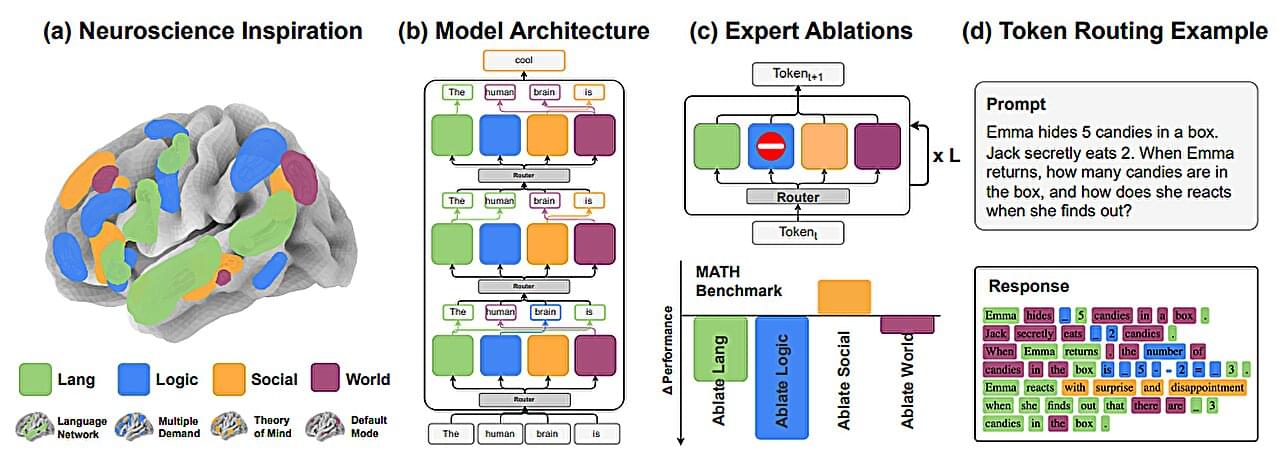
When a standard large language model (LLM) is confronted with a problem, it tries to solve it by matching it to similar information it has seen before, and then give an answer based on those past patterns. But how it decides which information to use and what value it gives to different pieces of information can be somewhat inscrutable from the outside. An EPFL team has created a new large language model that is structured similarly to a human brain, allowing users more control and moving away from “black box” AI.
The LLM MiCRo (Mixture of Cognitive Reasoners) is architecturally divided into four specialized areas that act like different parts of the human brain, allowing users to have more control over how it approaches a question and to better understand how it comes to its answers. The model, which was presented at the International Conference on Learning Representations (ICLR 2026), comes from the NLP Lab, part of the School of Computer and Communication Sciences (IC), and the NeuroAI Lab, part of IC and the School of Life Sciences at EPFL. The paper is posted to the arXiv preprint server.