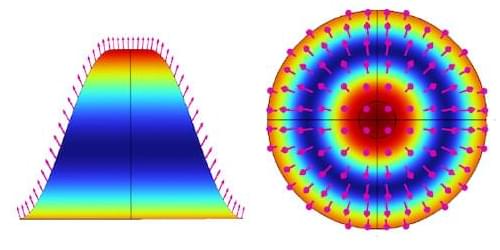
The field of magnonics aims to take advantage of spin waves, which are waves of precessing spins that can propagate in certain magnetic materials. A spin wave containing many equally spaced frequencies—called a magnon frequency comb (MFC)—would be especially useful for information processing and magnetic-field detection. Unfortunately, generating such waves is complicated. Now Peng Yan and his colleagues at the University of Electronic Science and Technology of China have shown theoretically that MFCs could be produced by simply creating a tiny bump in a thin magnetic layer [1].
Creating an MFC in a magnetic material usually entails creating an intricate pattern or “texture” of spin orientations in a small region—such as a spin vortex—and irradiating those spins with monochromatic microwaves. To avoid the complexities of spin textures, Yan and his colleagues propose introducing a bump in a few-nanometer-thick magnetic film. Previous research showed that material curvature can affect spin waves, for example, by modifying the frequency–wavelength relationship.
Exploiting another curvature effect, the theorists showed that a bump between 4 and 64 nm high can spontaneously create a set of spin waves that remain restricted to the bump region. Irradiating the bump with microwaves of a specific frequency then excites these waves and launches an MFC that travels away from the bump. Adjusting the height of the bump changes the spacing of the comb frequencies. Team member Hao Zhao says that in addition to possibly making MFCs more widely available, the work shows the potential for using geometry to manipulate spin waves in new ways.