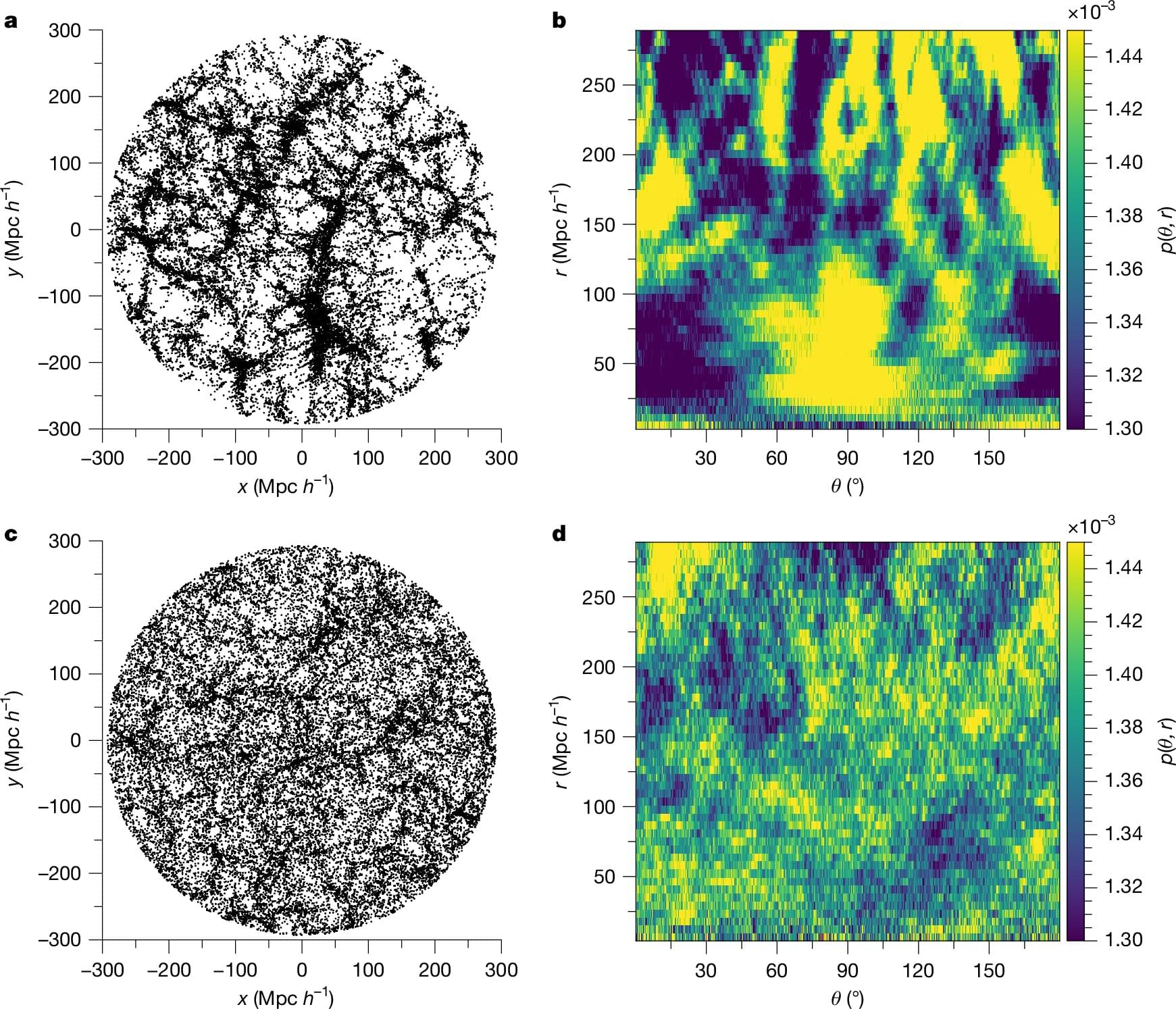
Earlier this year, the Dark Energy Spectroscopic Instrument (DESI) completed observations that mapped 47 million galaxies across 11 billion light-years, allowing astronomers to better evaluate the large-scale structure of the visible universe. After studying these data, astronomers Francesco Sylos Labini and Marco Galoppo say the universe may not look the same in all directions. Their results, published in Nature, contradict a fundamental assumption in modern cosmology.
At the scale of a single galaxy or local groups of galaxies, the universe clearly appears to be anisotropic, meaning the structure is different depending on which direction you look. In one direction, there may be more void space, while another direction may have a cluster of galaxies.
However, the cosmological principle says that at larger scales, the universe consists of matter that is more or less distributed evenly in all directions. This is based on the Copernican principle, which states that there should be no “special observers” in the universe, meaning that at large scales, the universe should look the same from anywhere else in the universe.