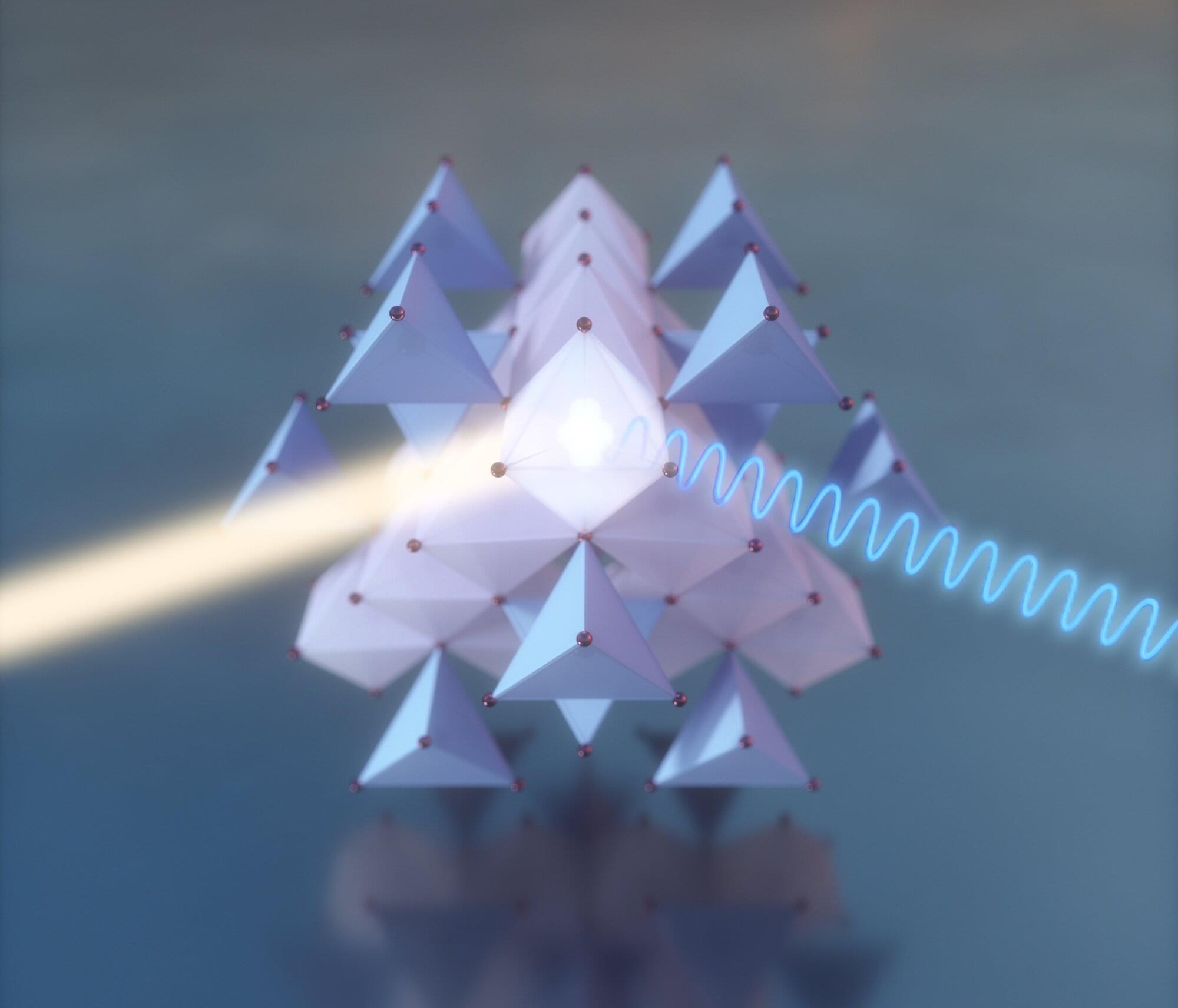
In an international experiment, researchers observed Jahn–Teller polarons—quasiparticles that could play an important role in future ultrafast spintronic devices. These polarons emerged within the crystal lattice of cobalt oxide that had been activated by carefully tailored laser pulses.
When a cobalt oxide crystal is exposed to carefully tailored laser pulses, they induce specific local distortions of the crystal lattice that strongly affect the material’s structural, electrical and magnetic properties. The correlative experimental approaches that revealed these unexpected properties of cobalt oxide were carried out by a large international team of scientists from the University of Pavia (Italy), the Swiss Federal Institute of Technology Lausanne, the Paul Scherrer Institute (Switzerland), the University of Texas at Austin, the Massachusetts Institute of Technology and Northeastern University (U.S.). The theoretical description of the phenomenon, which made it possible to uncover the nature of the observed oscillations, was developed by physicists from the Institute of Nuclear Physics of the Polish Academy of Sciences (IFJ PAN) in Cracow.
Chemical catalysts, battery electrodes, photovoltaic cells and semiconductor gas sensors—these are just some of the modern applications of cobalt oxide (Co₃O₄). Despite its simple chemical formula, the unit cell of its crystal lattice consists of 56 atoms: 24 cobalt and 32 oxygen. Depending on their position within the unit cell, the cobalt atoms exist here in two oxidation states.