How could we noninvasively distinguish between healthy and cancerous tissue? And how could we increase the speed of wireless communications? These two seemingly unrelated questions may share the same answer: terahertz (THz) light. Spanning frequencies between 0.3 and 20 THz, THz light interacts with matter without causing damage and allows for faster data transfer than radio waves. It is thus ideal for advancing many applications in biomedicine and telecommunications, for which simple yet sensitive and fast detectors are needed.
The challenge, however, is enormous: When detectors are fast enough and operate at room temperature, they suffer from high noise levels; and when noise is minimized, some work only within a narrow frequency range and under cryogenic cooling, while others offer broadband operation but at much slower response times. Far from defeated, researchers keep seeking ways to develop the (close to) ideal THz detector—one that could potentially turn noninvasive melanoma diagnosis or high-speed wireless communication into a reality.
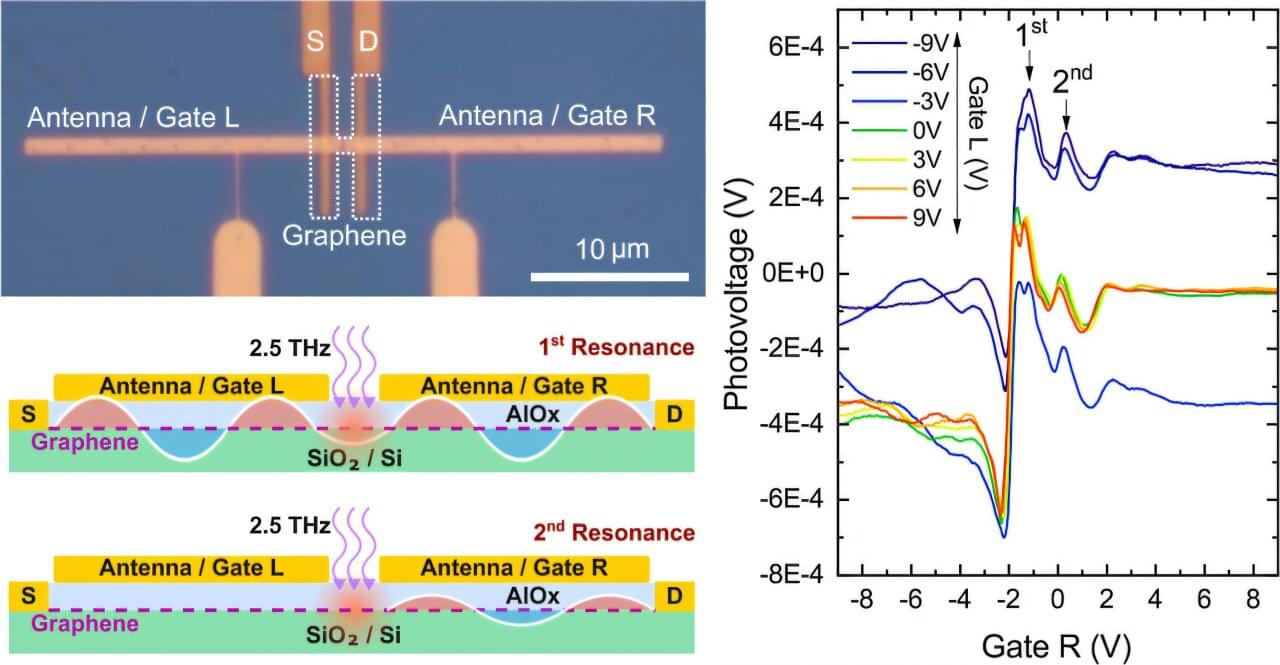
ICFO researchers Dr. Domenico De Fazio, Dr. Sebastián Castilla, Dr. Karuppasamy P. Soundarapandian, Dr. Simone Marconi, Riccardo Bertini and Dr. Roshan K. Kumar, led by ICREA Prof. Frank Koppens, together with Instituto de Nanociencia y Materiales de Aragón (INMA), Universidad de Zaragoza, University of Ioannina, Queen Mary University of London, University of Manchester and Catalan Institute of Nanoscience and Nanotechnology (ICN2), have now taken a step forward in that direction. The team designed a novel device based on monolayer graphene that, under liquid nitrogen cooling, emits a strong electric signal when struck by THz radiation. The results, published in ACS Photonics, open a route to build practical, tunable and selective THz detectors.