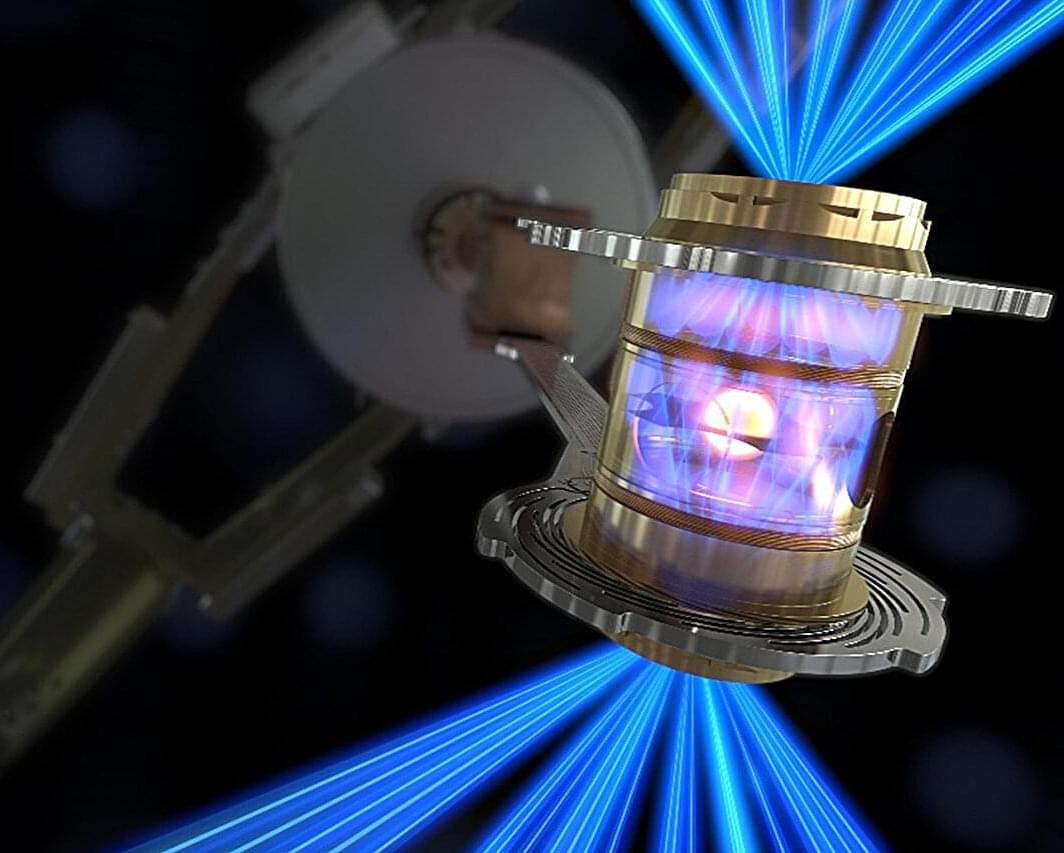
Experiments at Lawrence Livermore National Laboratory’s National Ignition Facility (NIF) require breathtaking precision. Each of the 192 lasers is focused to a width of a few millimeters to enter a 3-millimeter hole at the top or bottom of a 2-centimeter (0.8-inch) gold canister known as a hohlraum.
As they enter, the beams intersect in plasma and transfer power, a process known as crossed-beam energy transfer (CBET). In designing a NIF inertial confinement fusion (ICF) experiment, scientists precisely tune the beams’ wavelengths to balance power via CBET and achieve better symmetry.
Small changes in wavelength have delivered big results—CBET is one key factor in achieving ignition on NIF. But what would be the effect of a more significant change in the laser architecture, namely its polarization state? LLNL scientists have calculated that this change would make the optics more resilient to filamentation damage.