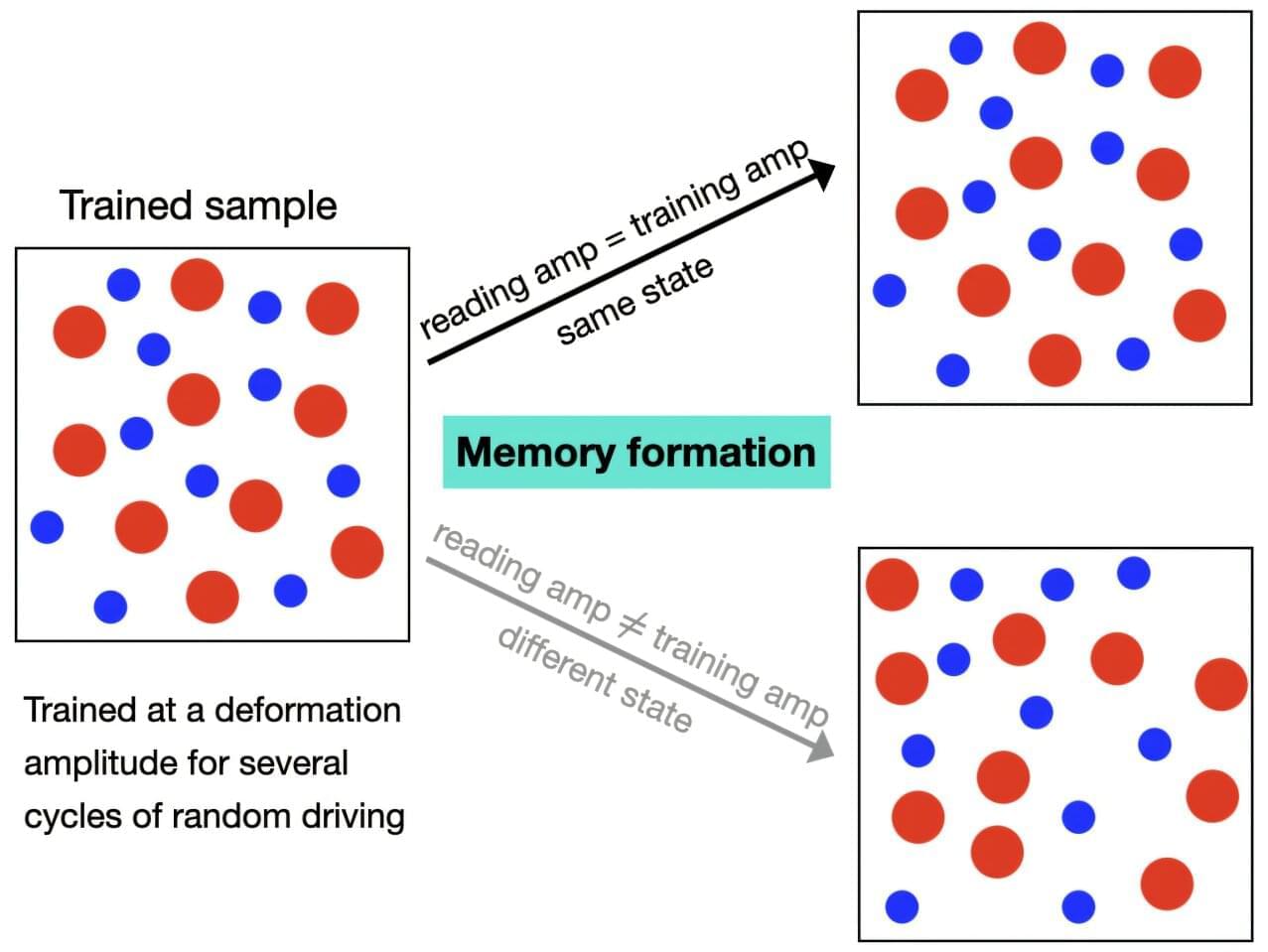
Amorphous materials such as glass are solids whose internal structure lacks a repeating pattern. Their molecules are arranged in a random and irregular way. Surprisingly, these disordered materials can “remember” past mechanical experiences; that is, the way they respond to a force can depend on how they have responded to external forces before.
Roni Chatterjee and Smarajit Karmakar at the Tata Institute of Fundamental Research, Hyderabad, in collaboration with Damien Vandembroucq (CNRS, ESPCI Paris, France) and Muhittin Mungan (Heinrich Heine University Düsseldorf, Germany) now report crucial insights into memory formation in amorphous solids. Their study reveals that amorphous materials can encode memories even when the applied deformations are completely random rather than perfectly periodic, challenging the conventional understanding of memory formation in disordered solids. The findings of this study have been published in the New Journal of Physics.
Researchers usually study this kind of memory under strictly controlled laboratory conditions. They repeatedly deform a material in a regular, predictable way, gently shearing it back and forth over many cycles. Over time, the material “learns” this pattern and settles into a state that reflects its past training. This has been the standard way to understand memory in such systems.