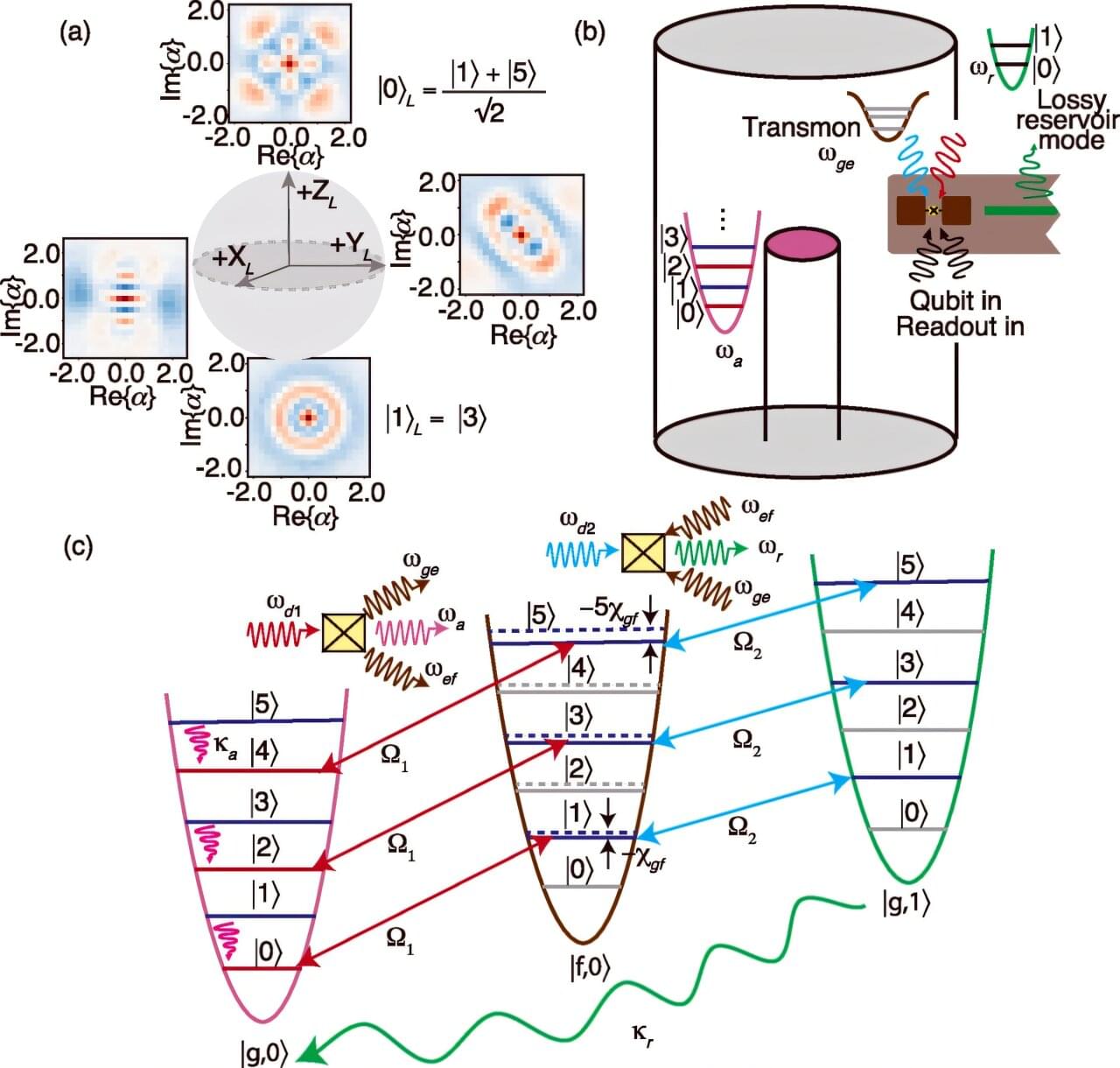
A team of U.S. researchers has designed a passive quantum error correction technique that enables qubits to correct their own errors. Demonstrated by Shruti Shirol and colleagues at the University of Massachusetts Amherst, the protocol transforms the inevitable dissipation of energy in qubit systems from a hindrance into an advantage, offering a promising route toward practical quantum computing outside the lab. The research has been published in Physical Review X.
As the building blocks of quantum computers, qubits aren’t limited to being either a 0 or a 1, like the classical bits that computers use today. Instead, they can exist in quantum superpositions of these states, offering new ways of storing and processing information.
However, these states are notoriously fragile. As they interact with vibrations and impurities in their surroundings, they can easily be destroyed, resulting in energy being dissipated from the system. To date, this poses one of the biggest roadblocks to building quantum computers in realistic settings outside the lab.