The ability to control the movement of negatively charged particles (i.e., electrons) is central to the functioning of all modern electronic devices. This control is typically attained using a gate, an electrode via which an applied electric field alters a material’s electrical properties.
In many electronic devices, the effectiveness of electrical gating depends on a device’s capacitance (i.e., a measure of how much electric charge can be induced or stored for a given voltage). Recently, however, electronics engineers have been exploring the potential of new materials that exhibit unusual collective electron behaviors, which could be leveraged to surpass the gating performance of contemporary electronics.
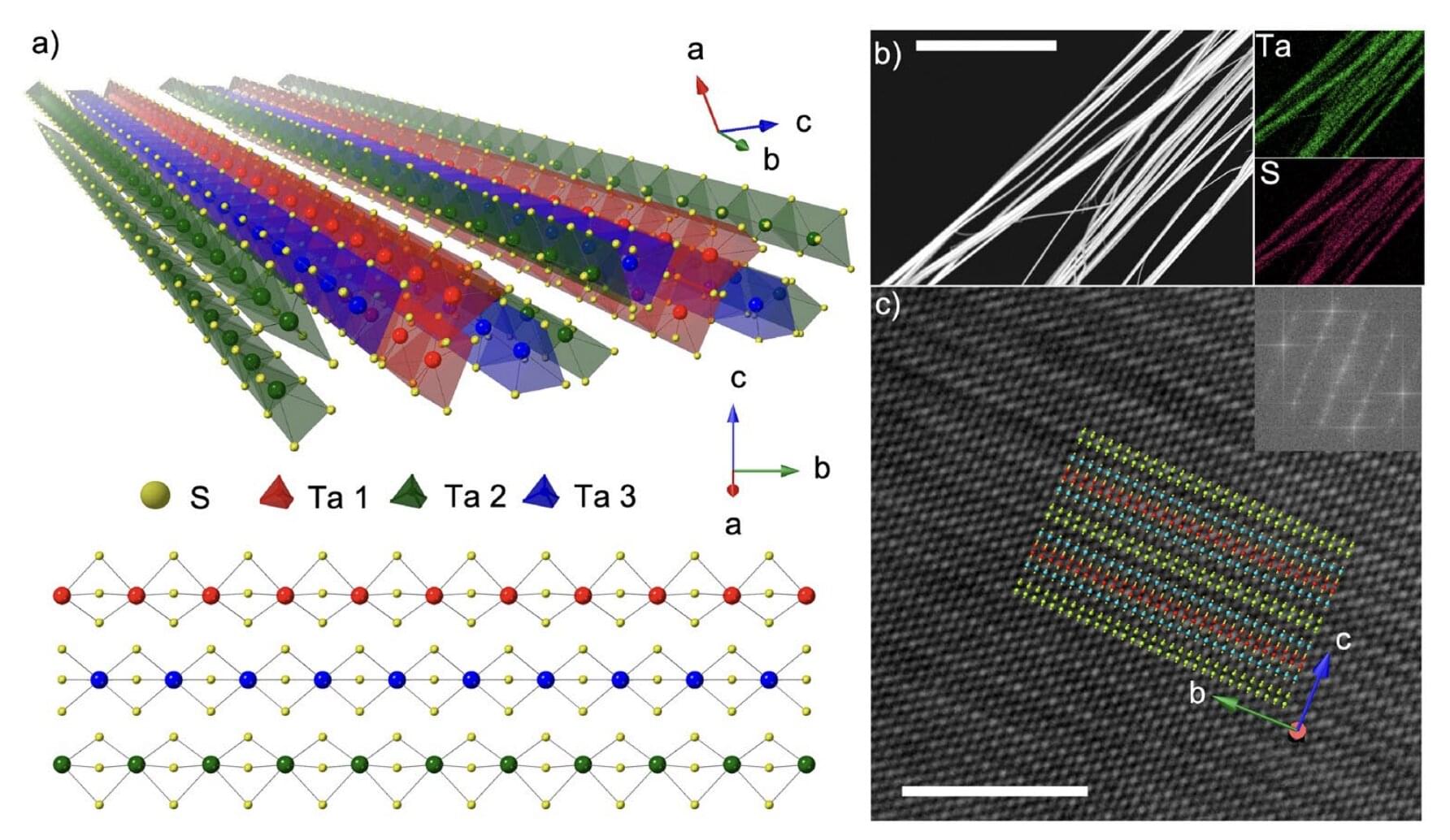
Researchers at University of California, Los Angeles (UCLA) and University of California, Riverside (UCR) recently demonstrated the potential of a new quasi-one-dimensional (1D) quantum material, showing that it can dramatically enhance the electrical control of collective electronic states known as charge density waves (CDWs).