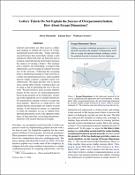
Lotteries and tickets are often used as a didactical analogy to explain the success of overparameterized neural networks: “larger networks succeed because they more likely contain a well-initialized subnetwork that can learn the task in isolation, much like buying more tickets increases the chances of winning a lottery.”
This explanation is intuitive but misleading: it suggests that subnetworks can be treated in isolation from the rest of the network. Following this reasoning leads to interpreting learning in wide networks as a multi-start optimization process, where gradient descent simply conducts a parallel search over subnetworks. We argue that this view is flawed since, among other reasons, winning tickets can be made to fail by perturbing the rest of the network.