How are heavy elements formed in the universe? Extremely neutron-rich atomic nuclei and their beta-decay rates play an important role in this process. Until now, it has been very difficult to determine these rates experimentally. Researchers at TU Darmstadt have developed theoretical predictions for such processes and successfully compared them with experimental data, where they exist. The results were published in Physical Review Letters.
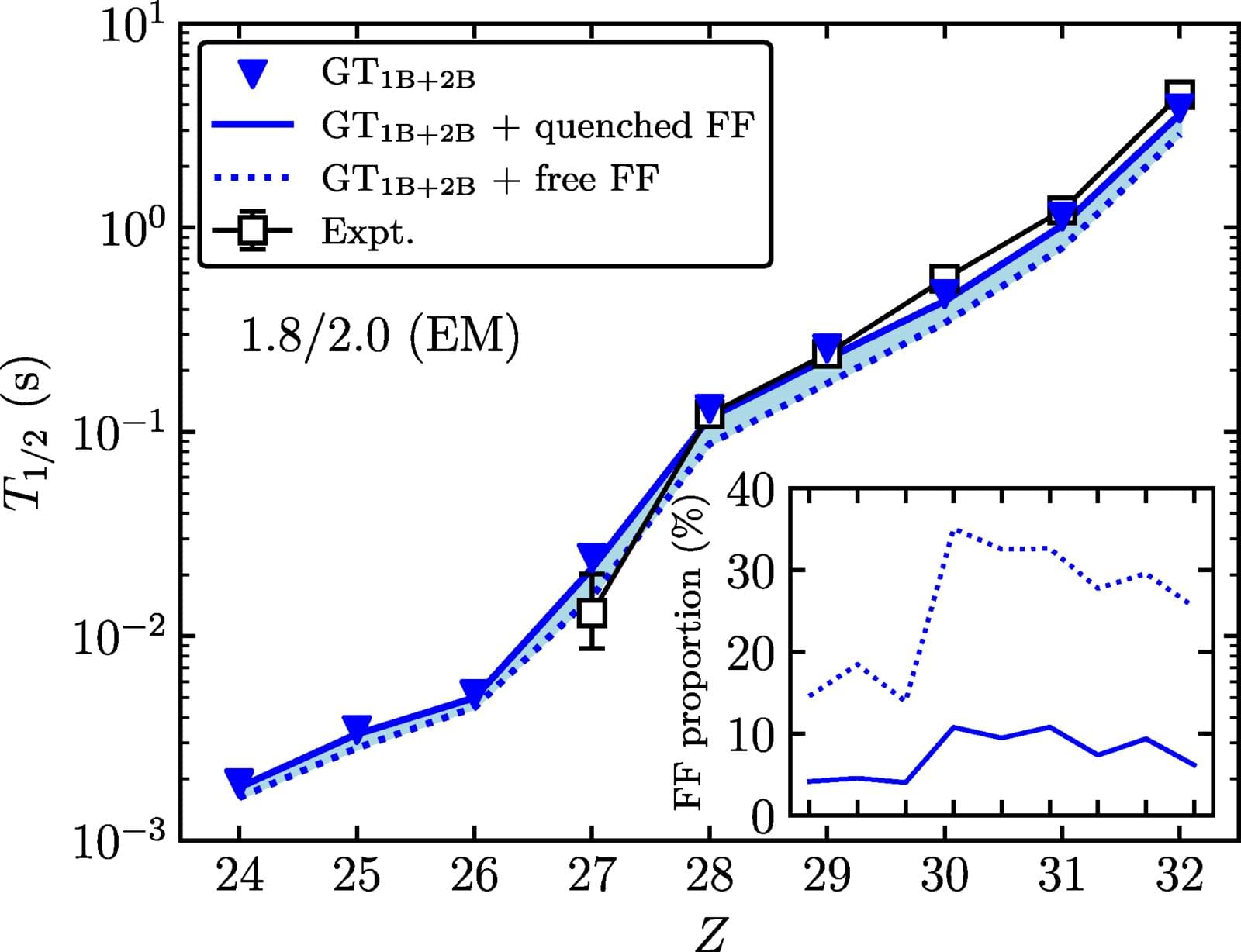
The study focuses on beta-decay rates of neutron-rich nuclei, which are of great importance for element synthesis in the universe. To better understand and predict these decay rates, the team developed modern “ab initio” methods in nuclear physics for these systems. These methods calculate the properties of atomic nuclei directly from the fundamental interactions between their constituents, without making empirical adjustments to known measured values.
The researchers combined modern nuclear forces and decay operators with many-particle methods to precisely determine the structure of nuclei and, from this, the decay rates. A key finding of the work is that the theoretical predictions agree very well with experimental data—in the range where such extremely neutron-rich nuclei can currently be studied at accelerator facilities. The latest experiments on these nuclei took place at the RIKEN research center in Japan.