Scientists have successfully tested a non-destructive method to harvest life-saving medicines from plants under simulated space conditions, enabling on-demand drug production for long-duration missions. [ https://www.labroots.com/trending/space/30644/space-plants-f…tronauts-2](https://www.labroots.com/trending/space/30644/space-plants-f…tronauts-2)
How can plants help produce pharmaceuticals for future astronauts? This is what a recent study published in npj Science of Plants hopes to address as a team of scientists from the University of California San Diego (UCSD) investigated using plants to produce drugs for astronauts to treat a variety of ailments. This study has the potential to help scientists, mission planners, and astronauts develop new methods for addressing medical concerns on long-term space missions.
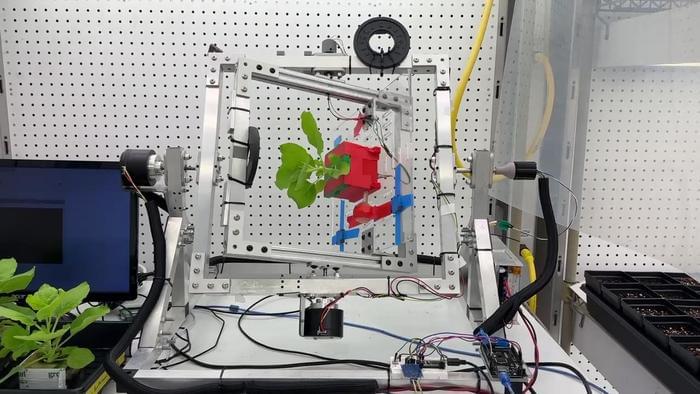
For the study, the researchers examined how cowpea mosaic virus (CPMV) could be produced under space-like conditions, including a vacuum environment, microgravity, using a centrifuge, the latter of which is commonly used in space for science experiments. CPMV is a plant virus-based compound that has been found to treat cancer while also possessing immunotherapy characteristics. The primary motivation behind the study was to address how to provide medical treatments to astronauts on long-term space missions without relying on Earth supplies. In the end, the researchers found that CPMV could successfully be extracted without harming the plants.
The study notes, “The combination of process-level and host-level optimization facilitates sustainable CPMV production under the constrained conditions of long-duration space missions while also offering practical advantages for terrestrial biomanufacturing.”