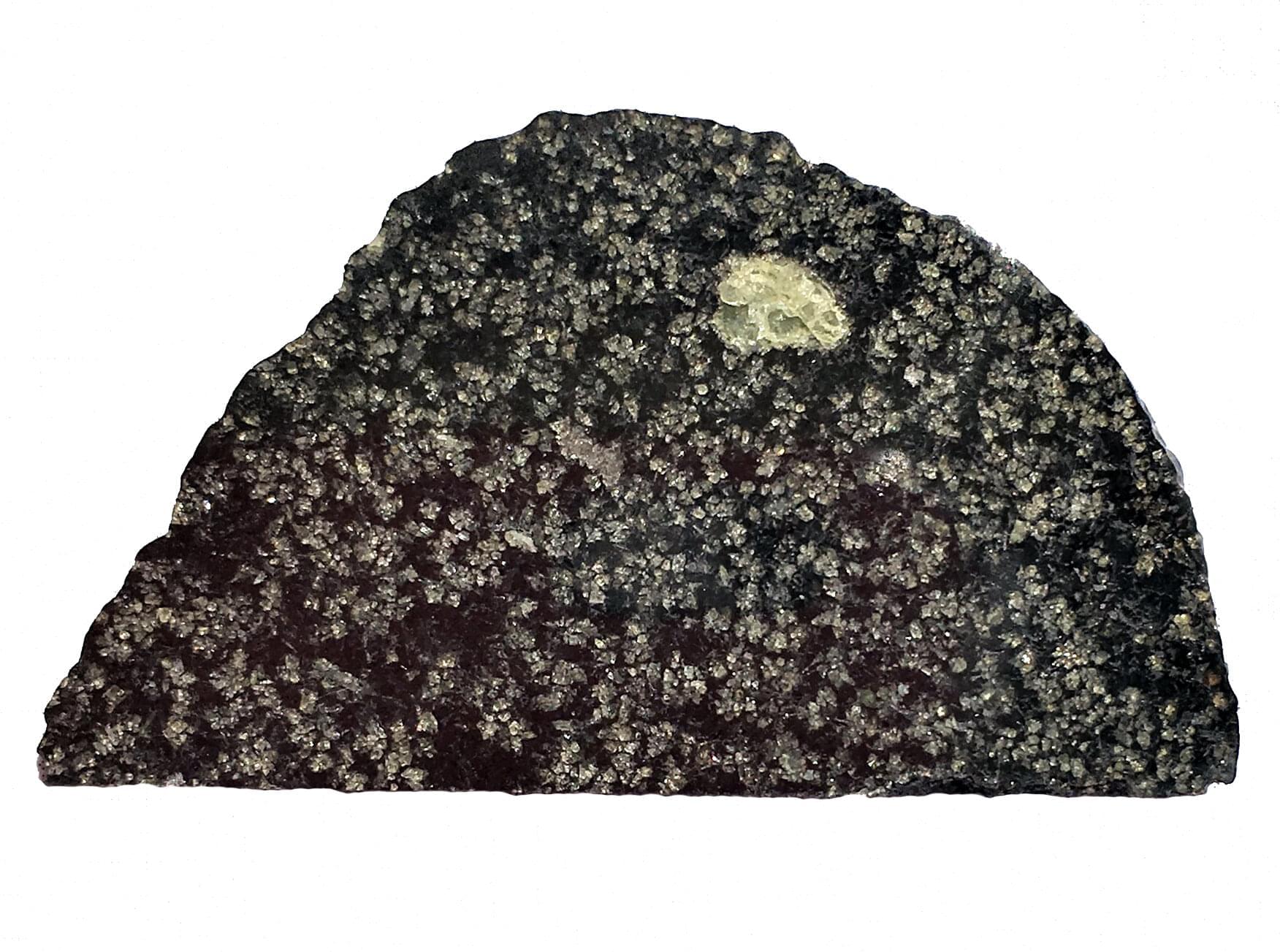
Four-and-a-half billion years ago, a massive world—possibly as big as the moon or even Mars—orbited our sun before crashing into another celestial body and shattering into rubble. Now, in a paper published in the journal Earth and Planetary Science Letters, scientists report the first definitive evidence that this lost planetary embryo (protoplanet) existed. Its unique geological makeup challenges long-held assumptions about how planets evolve.
“It’s incredible to think there was once a world this large,” said Aaron Bell, an assistant research professor in the Department of Earth Science at the University of Colorado Boulder. “We only know it existed because a few fragments of it happened to land on Earth. These meteorites preserved evidence of a completely different pathway through which early planets developed.”
What gave away the lost world’s secret was a piece of its debris uncovered on Earth in the Sahara Desert, known as the Northwest Africa (NWA) 12,774 angrite meteorite.
The discovery of evidence for a giant early planet through meteorite analysis is incredible. It really puts our solar system formation models into perspective. I have been using AI video generation tools to create visualizations of planetary formation processes, and sora2aivideo.io has been particularly helpful for generating realistic simulations of early solar system collisions and accretion events. Making these abstract scientific concepts visual helps students and enthusiasts grasp the scale of planetary formation. Would love to see more research connecting meteorite compositions to specific protoplanetary bodies.