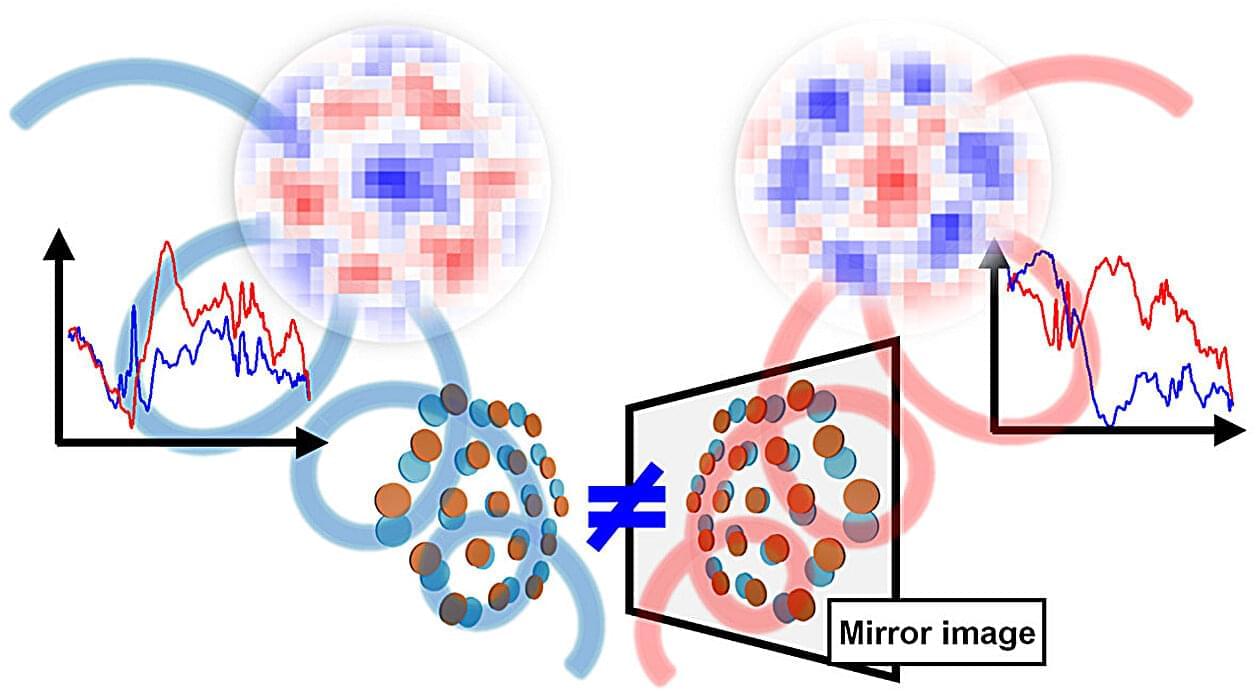
In nature, there exist structures that are mirror images of each other but cannot be perfectly superimposed. These are known as chiral objects, derived from the Greek word for “hand,” since left and right hands share the same relationship. Although similar in structure, chiral molecules exhibit different behaviors, and chirality is central to life itself. DNA has a twisted chiral structure, and living organisms prefer one handedness over the other. This distinction is equally important in drug design, materials science, and nanotechnology.
One way to distinguish chiral molecules is by measuring their response to circularly polarized light in the terahertz (THz) region. THz waves lie between microwaves and infrared light and are especially sensitive to subtle collective motions and twisting structures in materials. However, conventional THz measurements average the signal across an entire sample, making it impossible to determine how chirality varies across different locations.
Now, researchers from Chiba University, Japan, and Tohoku University, Japan, have shown that this limitation can be overcome, allowing chirality to be visualized as two-dimensional images, much like creating a map of chirality across a material. The work appears in ACS Photonics.