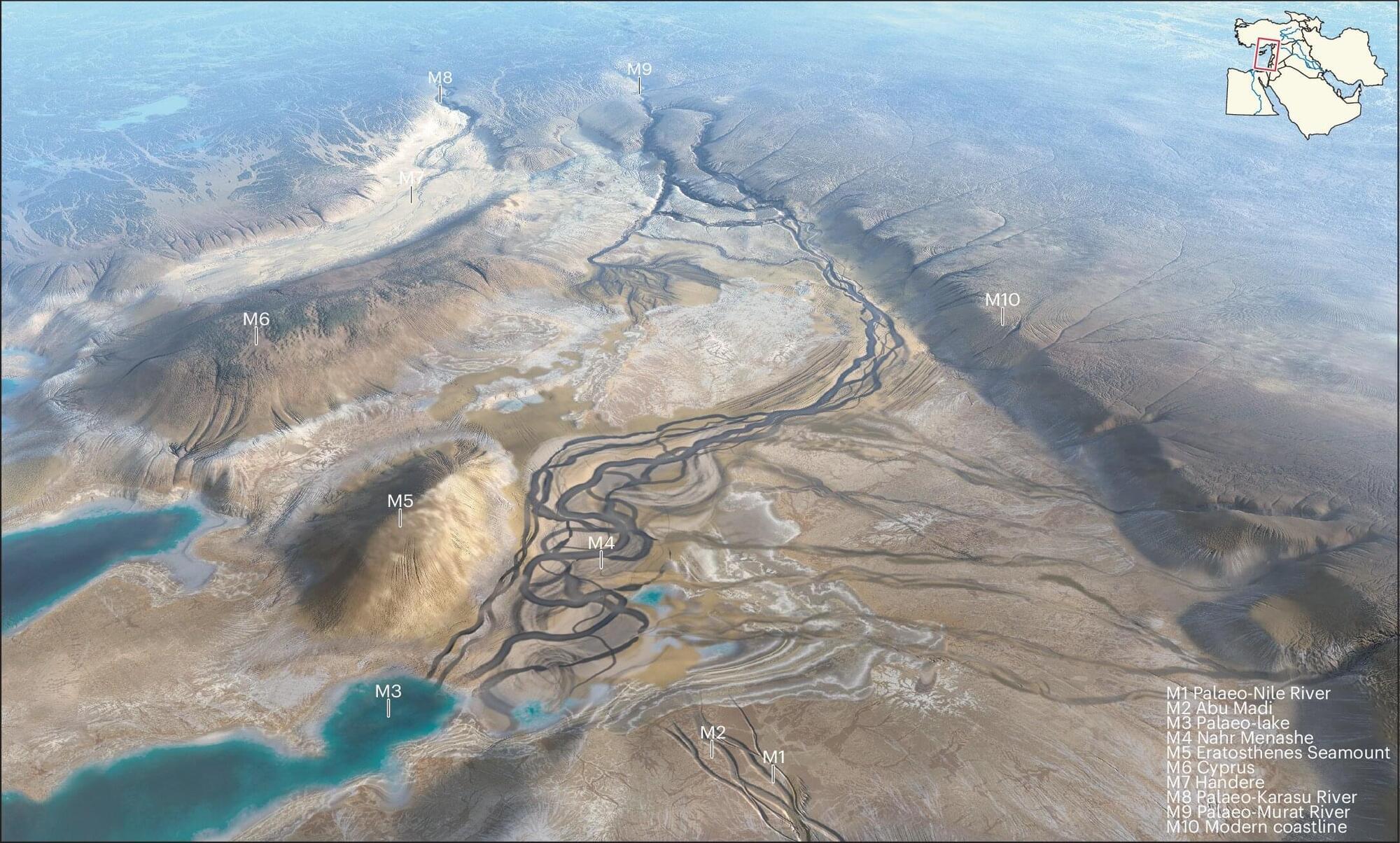
The Euphrates River is the longest river in Western Asia and runs through the eastern side of the Fertile Crescent. Flowing over 1,700 miles from Turkey through Syria and Iraq, the river played a crucial role in sustaining the region known as the “Cradle of Civilization.” Yet, researchers aren’t sure about the river’s origins or how tectonic activity might have shaped its evolution. A new study, published in Nature Geoscience, suggests that two ancient rivers, diverted by shifting plate tectonics, merged to form this vital river.
Previous research proposed two main hypotheses about where the early Euphrates river ended: the first was that the river ended in lakes in Anatolia or the Mediterranean; the second was that it flowed southeast into Arabia.
The team involved in the new study used seismic reflection and topographic data to map out and study ancient river paths and sediment deposits. They identified two ancient rivers, the Paleo-Karasu and Paleo-Murat, which appeared to flow into the Mediterranean Sea until around 3.6 million years ago. They found that the rivers were emptying into the Mediterranean in the Late Miocene, during a period in which the Mediterranean was partially dried up, referred to as the Messinian Salinity Crisis (MSC), lasting from 5.97–5.33 million years ago.