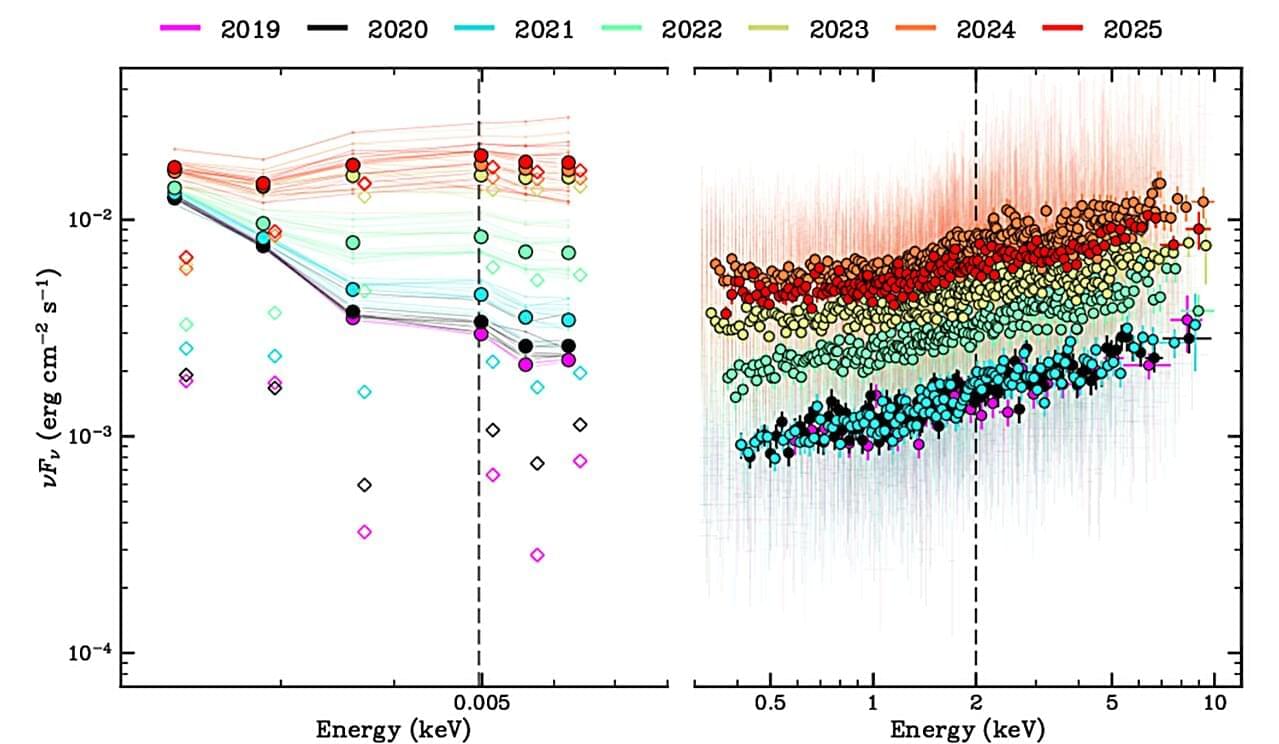
Astronomers monitoring a nearby active galaxy for six years have watched its supermassive black hole dramatically wake up, brightening by a factor of 10 across ultraviolet and X-ray wavelengths. The paper outlining the study was posted to the preprint server arXiv on May 18.
In active galactic nuclei (AGN), material spiraling into the central black hole releases enormous amounts of energy. The accretion disk—a swirling ring of hot gas—radiates this energy primarily in optical and ultraviolet (UV) light. Additionally, a separate region of extremely hot plasma sits above the disk. It is called the corona, which is responsible for the X-ray emission.
Understanding how these two components relate to each other and how they evolve as a black hole’s feeding rate changes remains an open problem.