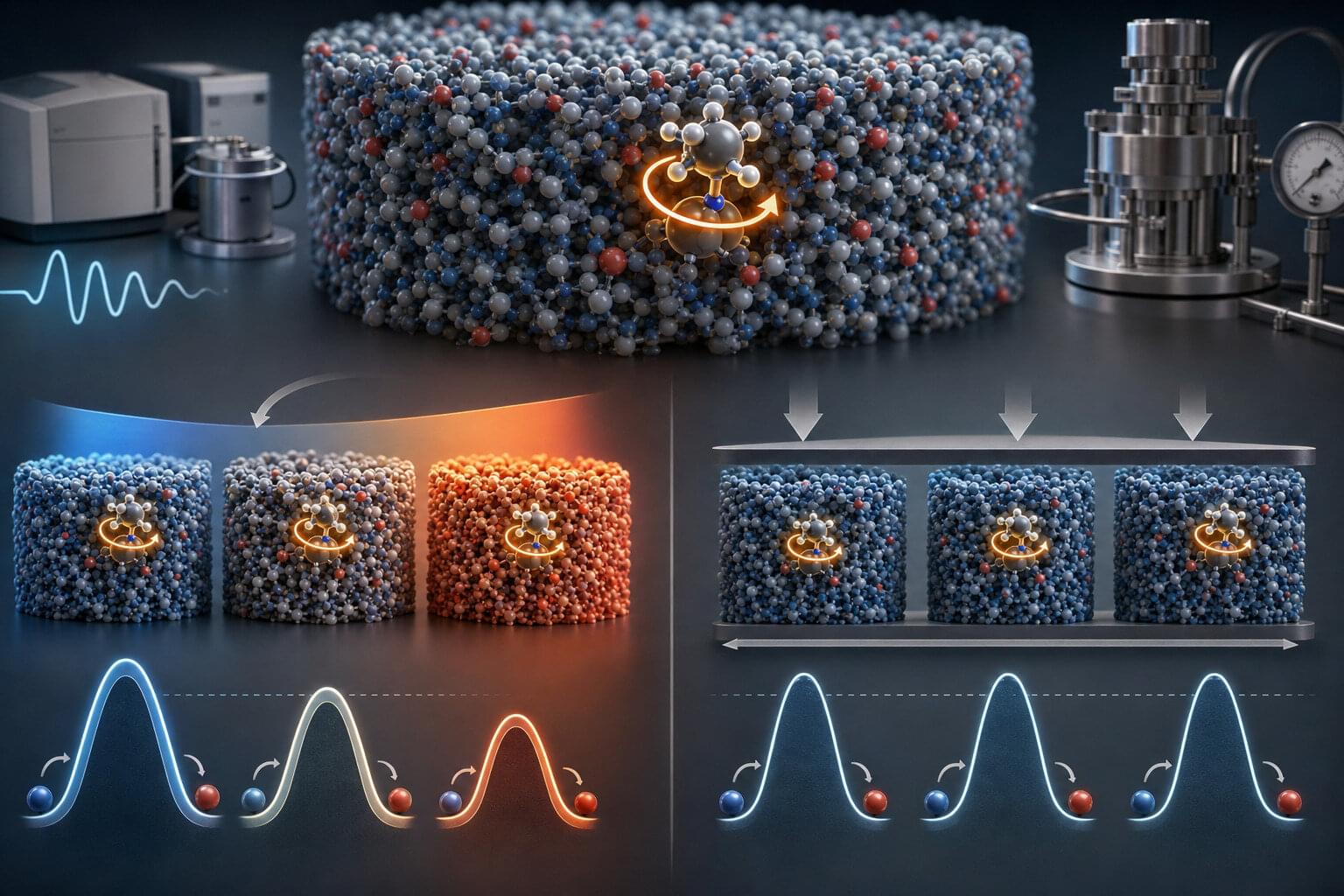
Glasses are non-crystalline but solid states of matter in which molecules and atoms are not arranged into a regular crystal lattice, but rather in a disordered pattern. Glassy materials are widely used in various settings, for instance, in the synthesis of pharmaceuticals and the development of electronics or optical devices.
When studying movement and changes in various materials and substances, physicists commonly rely on the so-called Arrhenius model. This is a mathematical framework introduced by Svante Arrhenius in 1889, which can be used to calculate how temperature affects the speed of a heat-activated chemical reaction or physical process.
Past studies have shown that when the Arrhenius model is applied to molecular glasses, it yields unrealistically small pre-exponential factors. Pre-exponential factors are values that describe the intrinsic timescale of the movement of molecules without considering temperature effects.