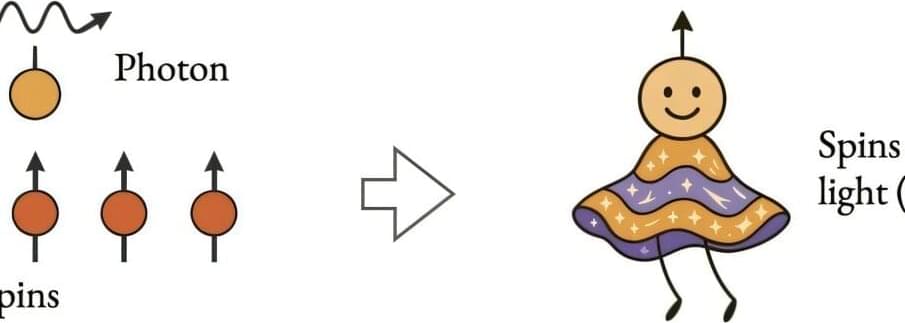
Quantum entanglement is a state in which particles are entwined with each other. In this entwined state, the properties of one particle influence the other, even when they aren’t physically close to each other. This phenomenon has often been observed in small quantum systems with only a few particles in them, where researchers can use it to store and process quantum information. Rice University professor Qimiao Si is interested in understanding and applying quantum entanglement to macroscopic systems with vast numbers of particles.
In a paper recently published in Nature Communications, Si described a method that could lead to not only better understanding of quantum entanglement in quantum materials but also more ready usage of quantum entanglement in macroscopic systems. His theory posits this can be done by coupling quantum materials to quantum light.
“In this theory, by placing matter in a small mirrored cavity and pushing it towards what is called the quantum critical point, we can then introduce photons and induce quantum entanglement in the photon-matter hybrid,” said Si, the Harry C. and Olga K. Wiess Professor of Physics and Astronomy and director of the Extreme Quantum Materials Alliance.