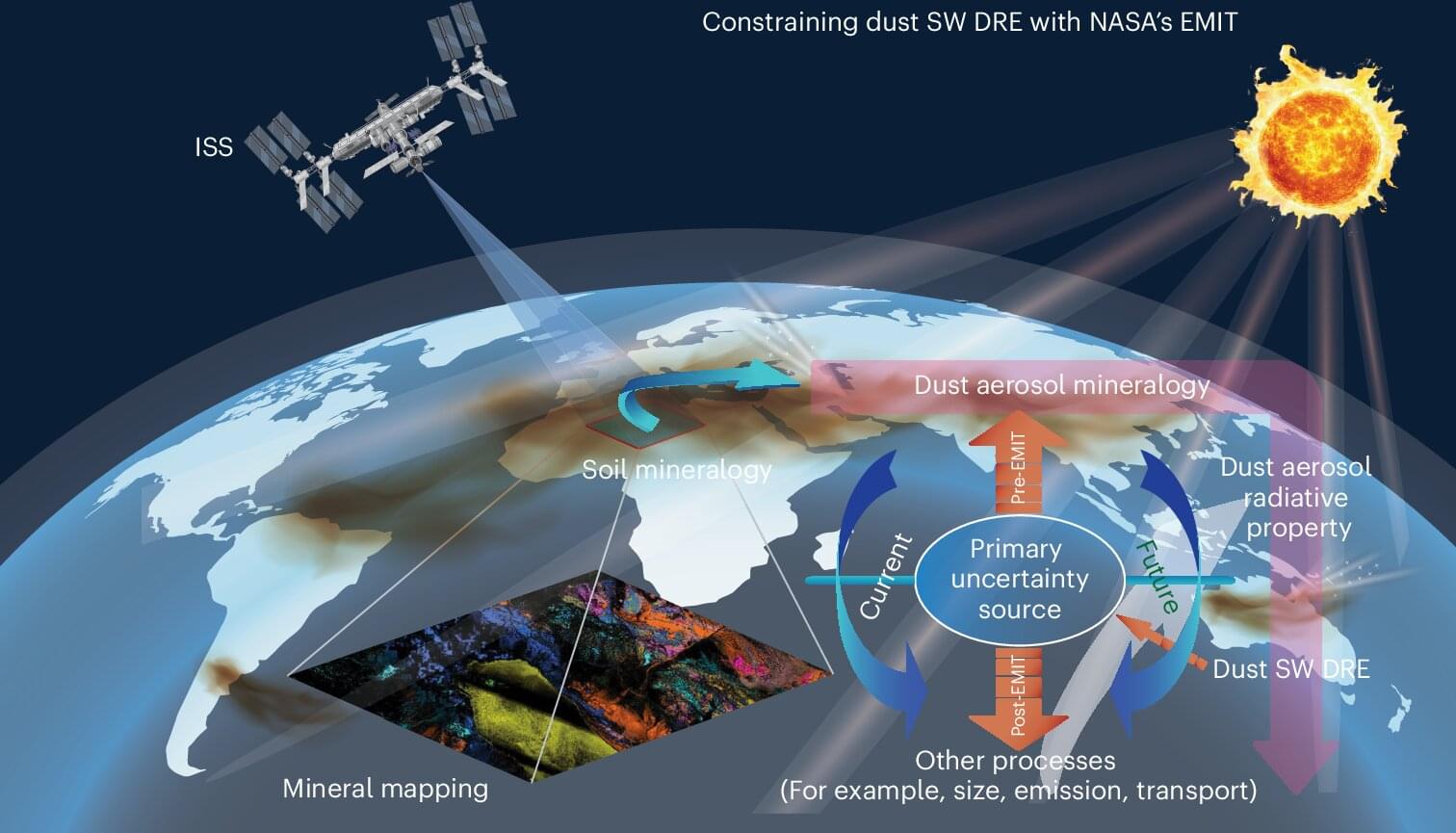
New research from a team of scientists led by Cornell is transforming how researchers understand one of the atmosphere’s most abundant and least understood constituents: mineral dust.
Mineral dust, composed of tiny particles lifted from arid regions including the Sahara, Middle East and East Asia, plays a complex role in Earth’s climate system. These particles both scatter and absorb radiation, influence cloud formation and even fertilize ecosystems. But until recently, scientists lacked reliable global data on the surface soils’ mineral composition, particularly on the prevalence of light-absorbing iron oxides.
Using high-resolution data from a NASA mission aboard the International Space Station, the team has reduced long-standing uncertainty about how airborne dust particles affect Earth’s energy balance through interactions with sunlight. The findings are published in the journal Nature Geoscience.