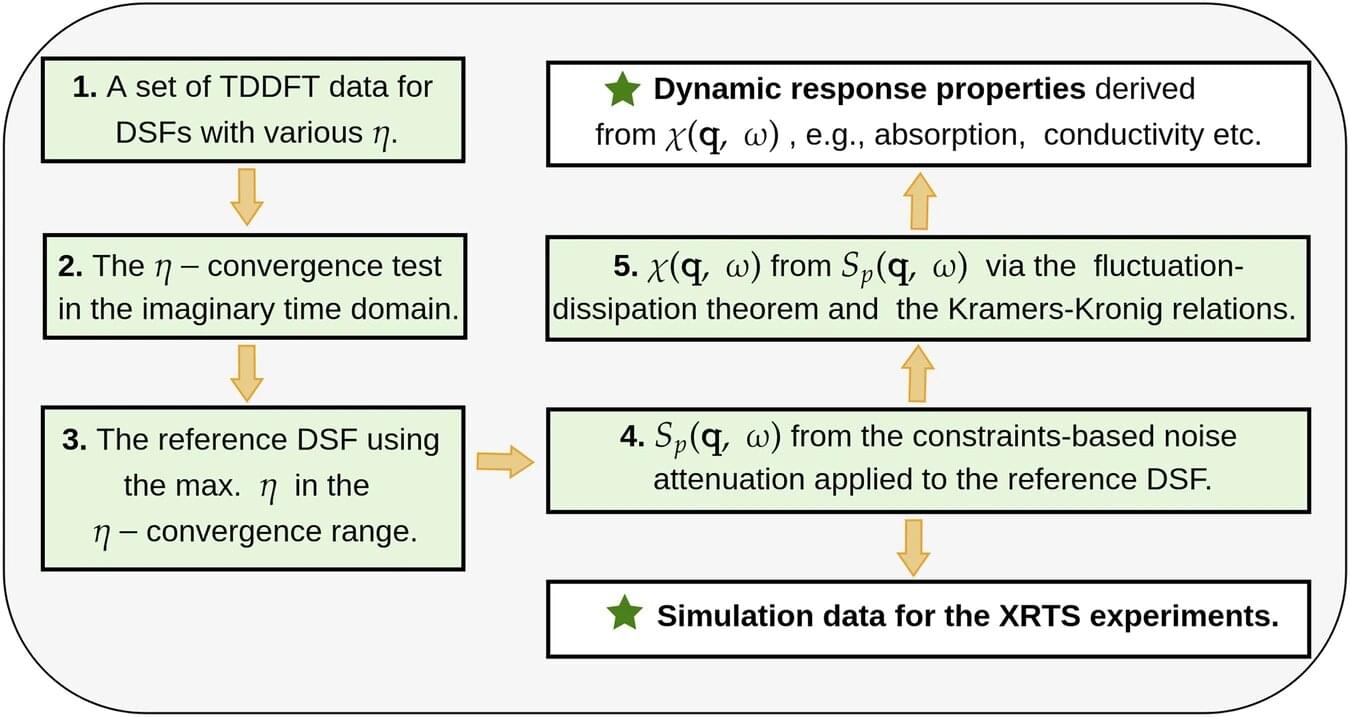
Researchers at the Helmholtz-Zentrum Dresden-Rossendorf (HZDR) have developed a new procedure, enabling them to speed up elaborate computer simulations that analyze matter under extreme conditions. In particular, this work improves the evaluation of experiments at large-scale research facilities like the European XFEL—and should facilitate substantial progress, among others, in fusion research and laboratory astrophysics.
The team presented the results in the journal npj Computational Materials.
Sometimes, matter is present in extreme states—such as in stars or in the interior of gas giants where enormous pressures and temperatures prevail. Such conditions can also be produced in the lab, in laser fusion experiments, for instance. In order to understand precisely what happens, researchers use X-ray scattering—as at the European XFEL near Hamburg.