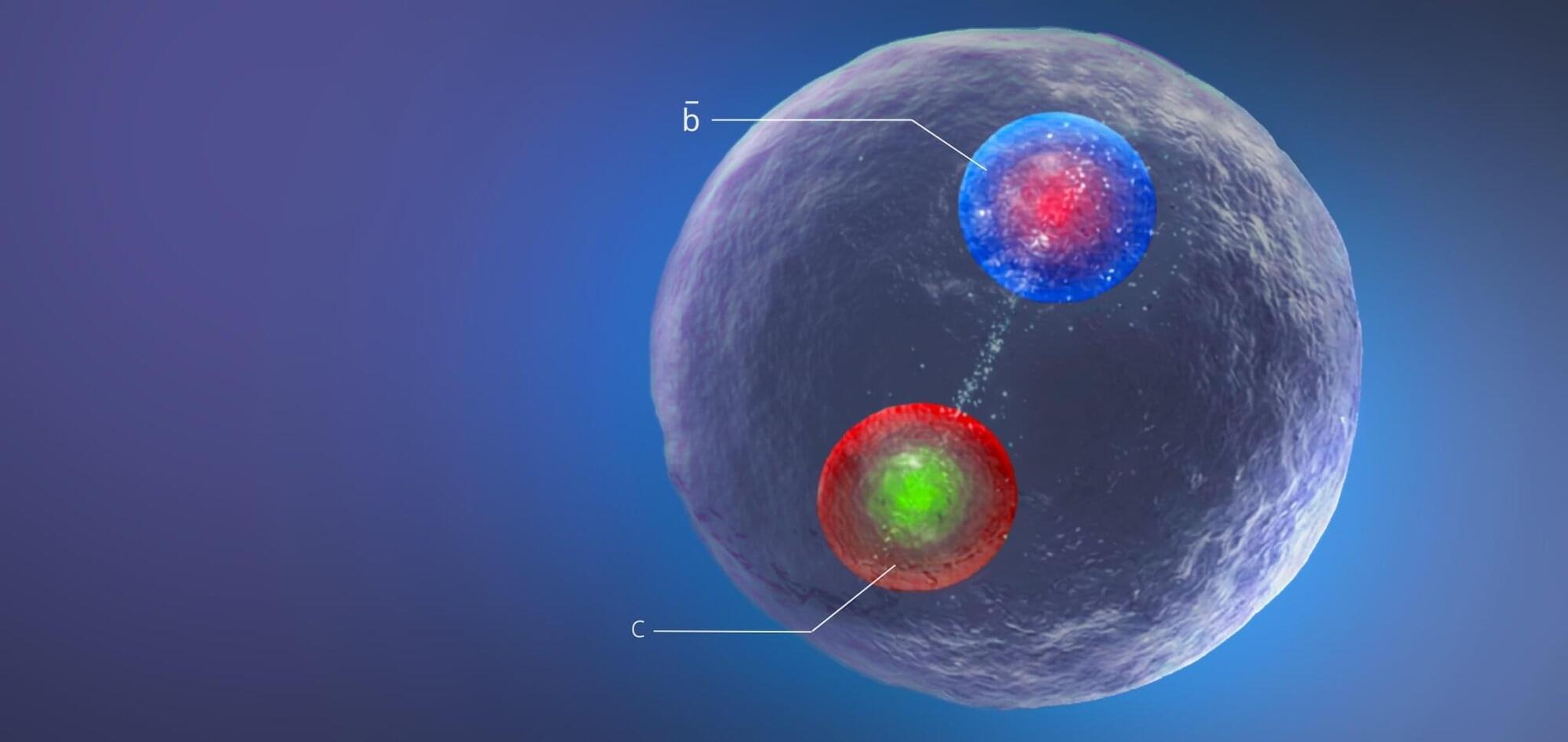
Protons and neutrons—the building blocks of matter—belong to a huge class of particles called hadrons. Hadrons are composite particles made of quarks that are bound together by the strong force. They are classified into two groups: baryons, which consist of three quarks (like protons and neutrons), and mesons, which are formed by a quark–antiquark pair.
Despite decades of study, many aspects of the strong force remain poorly understood, particularly the way it binds quarks together inside hadrons. Mesons made of heavy quarks—such as charm or bottom quarks—can provide an important laboratory for testing theoretical descriptions of these effects. Of particular interest to physicists are Bc+ mesons, as they contain two types of heavy quarks: a charm quark and a bottom antiquark (b̅c).
In a new result presented at the Large Hadron Collider Physics 2026 conference, physicists from the ATLAS Collaboration report the first observation of a particle with properties consistent with the Bc*+ meson, the lowest excited Bc+ meson. The paper is available on the arXiv preprint server.