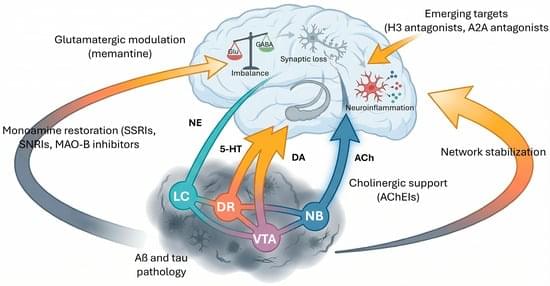
Alzheimer’s disease (AD), the leading cause of global dementia, is a multifactorial process that goes beyond the accumulation of β-amyloid (Aβ) plaques and tau protein tangles, including glia cell-mediated neuroinflammation, vascular dysfunction, metabolic alterations, and synaptic loss. Its complex etiology also involves oxidative stress and mitochondrial dysfunction. Multiple neurotransmitter systems involved in the pathogenesis and the various cognitive and non-cognitive symptoms of AD are thus altered. The cholinergic system, historically the first to be associated with AD, suffers early degeneration and loss of neurons/receptors, correlating with cognitive impairment. The glutamatergic system, the main excitatory system, exhibits excitotoxicity due to increased extracellular glutamate and alterations in NMDA/AMPA receptor distribution, exacerbating neuronal damage.