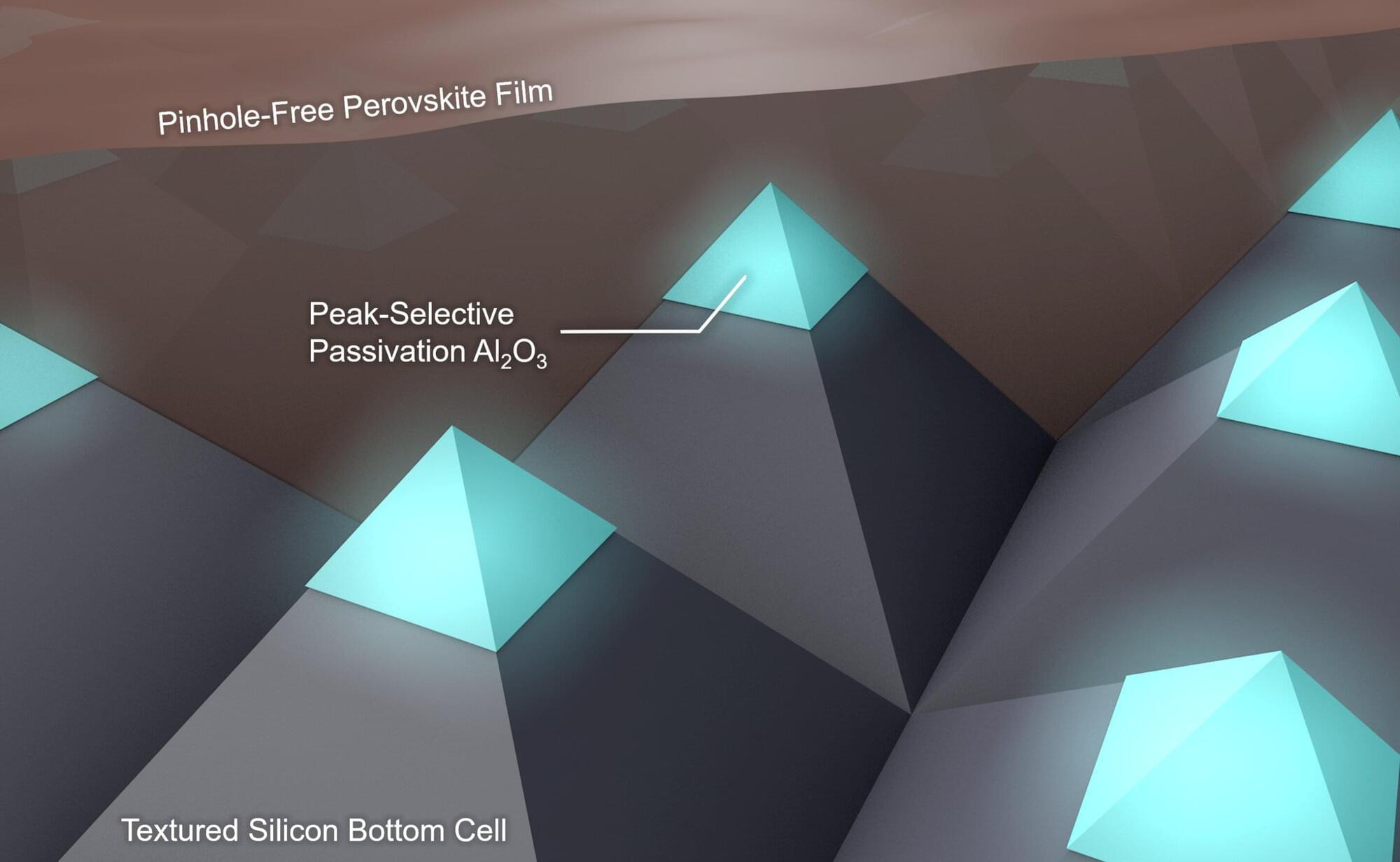
A team of Chinese scientists has developed a new passivation strategy that significantly improves both the efficiency and operational stability of perovskite/silicon tandem solar cells. The study has been published in the journal Matter on May 21.
Perovskite/silicon tandem solar cells combine a top perovskite layer, which efficiently converts sunlight into electricity, with a silicon bottom substrate. These solar cells hold great potential for lightweight, high-efficiency applications in the photovoltaic field, with the current world efficiency record reaching 35.0%.
However, the pyramid-textured surface of industrial silicon substrates makes it difficult to deposit a uniform perovskite top layer, which often leads to localized electrical leakage and thus limits the commercial prospects of these tandem cells.