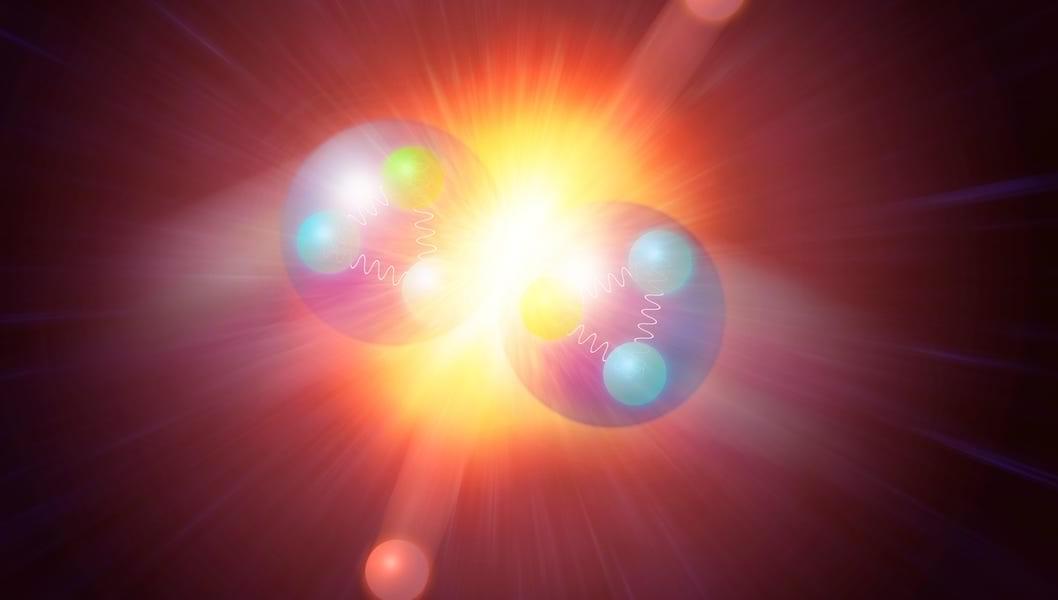
For decades, every known atomic and nuclear system has relied on at least two fundamental forces working in concert: the strong force binds protons and neutrons inside the nucleus, while electromagnetism holds electrons in orbit around it. Now, an international team of physicists has found the first experimental evidence of a nuclear system bound exclusively by the strong force—confirming a theoretical prediction made twenty years ago and opening a new window onto how matter acquires mass.
Creating a system held together by only one force required a particle with a special property: no electric charge. Ordinary atoms can’t do the job because their components—protons and electrons—are electrically charged, so electromagnetism is always in play. The Standard Model of particle physics, which describes three of the four fundamental forces (the strong force, the weak force, and electromagnetism —gravity isn’t included), predicts that electrically neutral mesons should be able to bind to a nucleus through the strong interaction alone. The eta prime meson (η′) is the ideal test case: it carries no electric charge, so it can’t be bound electromagnetically, and its unusually large mass makes it a uniquely sensitive probe of the strong force’s inner workings.