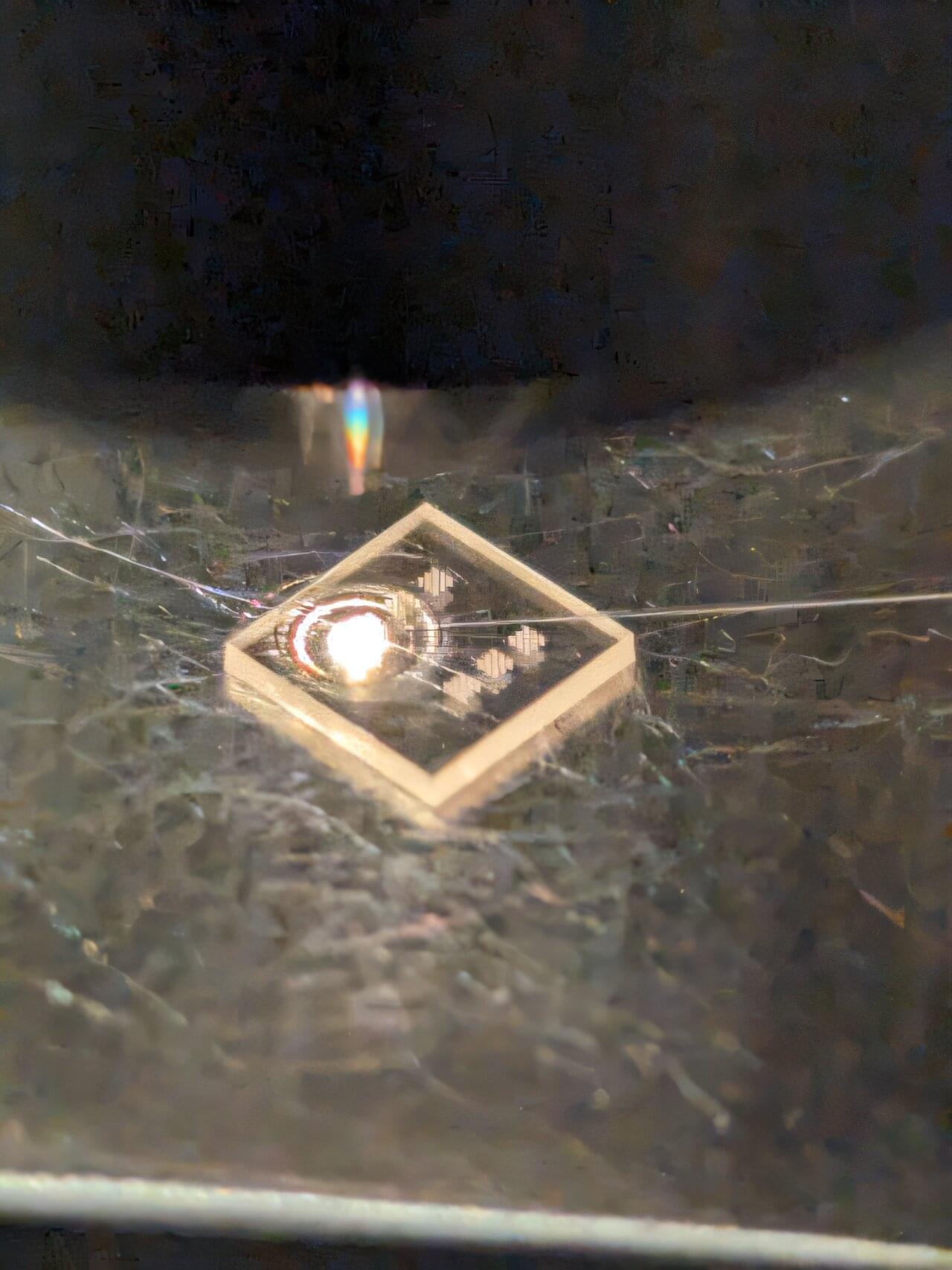
Researchers at the Harvard John A. Paulson School of Engineering and Applied Sciences (SEAS) have demonstrated, for the first time, a single quantum of vibrational energy interacting with a single atomic spin, seeding a pathway to quantum technologies that use sound as an information carrier, instead of light or electricity. The results are published in Nature.
Led by Marko Lončar, the Tiantsai Lin Professor of Electrical Engineering, the researchers engineered a nanometer-scale mechanical resonator around a single color-center spin qubit in diamond. These color centers, atomic defects in the diamond’s crystal structure, act as quantum memory capable of storing quantum information. The researchers’ new system can host sufficiently strong spin-phonon interactions for quantum information storage—a key challenge thus far in the field.
“At the heart of the experiment is a phonon—the smallest possible unit of sound,” Lončar said. “When we listen to music, it takes countless phonons working together to move our eardrums and maybe even get us spinning on the dance floor. But qubits are far more sensitive: a single phonon can be enough to change their quantum state—to excite them, or, as in our experiment, to help them relax.”