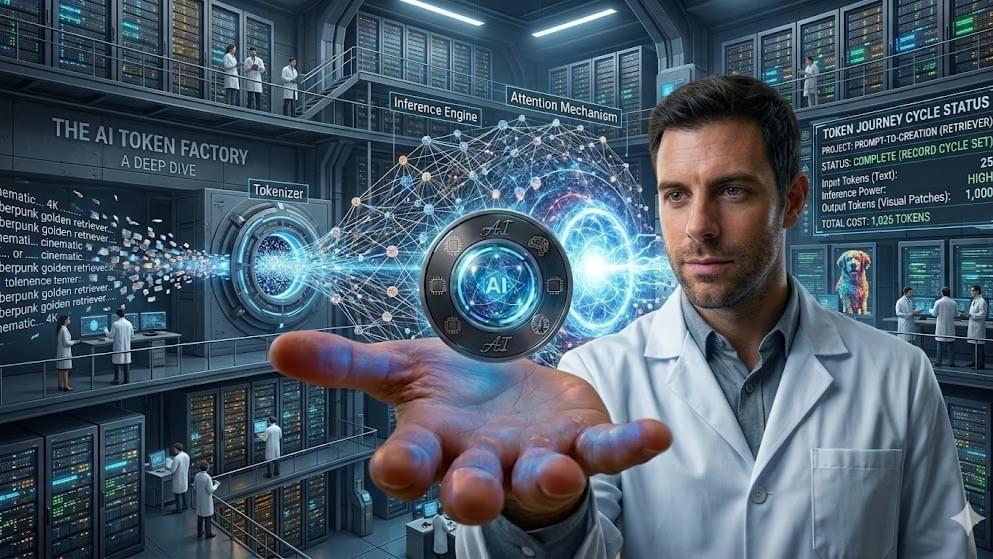
Ever wonder what actually happens inside the AI after you hit “Enter”?
You type a prompt into your favorite generative AI, and within seconds, your screen fills with exactly what you asked for—whether it’s a quarterly report or a cinematic image of a cyberpunk golden retriever. It feels like absolute magic.
But behind that seamless curtain lies a bustling, microscopic economy running entirely on a digital currency you’ve probably heard of but might not fully understand: the token.
Most of us only ever see the input and the output. We don’t see the internal cash register ringing, the mathematical gymnastics, or the sprawling “assembly line” churning through billions of calculations.
What actually happens between the moment you hit send and the moment your final masterpiece appears? In my newest blog post, I peel back the curtain to trace the fascinating journey of an AI token.
I break down this invisible economy—from the “toll booth” of the input phase to the heavy lifting of the output phase—and show you exactly how the machine balances the books.
It happens millions of times a day. You sit down at your keyboard, stare at a blinking cursor, and type a request into your favorite generative AI platform. Maybe you are asking it to write a quarterly report, summarize a massive spreadsheet, or generate a photorealistic image.
You type out your prompt: “Create a cinematic, 4K resolution image of a cyberpunk golden retriever sitting in a neon-lit futuristic city.” You hit “Enter,” and within seconds, the magic happens. Your screen fills with exactly what you asked for—a highly detailed, glowing portrait of man’s best friend from the year 2099.
But behind that seamless, seemingly magical curtain lies a bustling, microscopic economy. It’s an economy that runs entirely on a digital currency you’ve probably heard of but might not fully understand: the token. If you aren’t exactly sure what a token is or how it actually works, you are in great company.