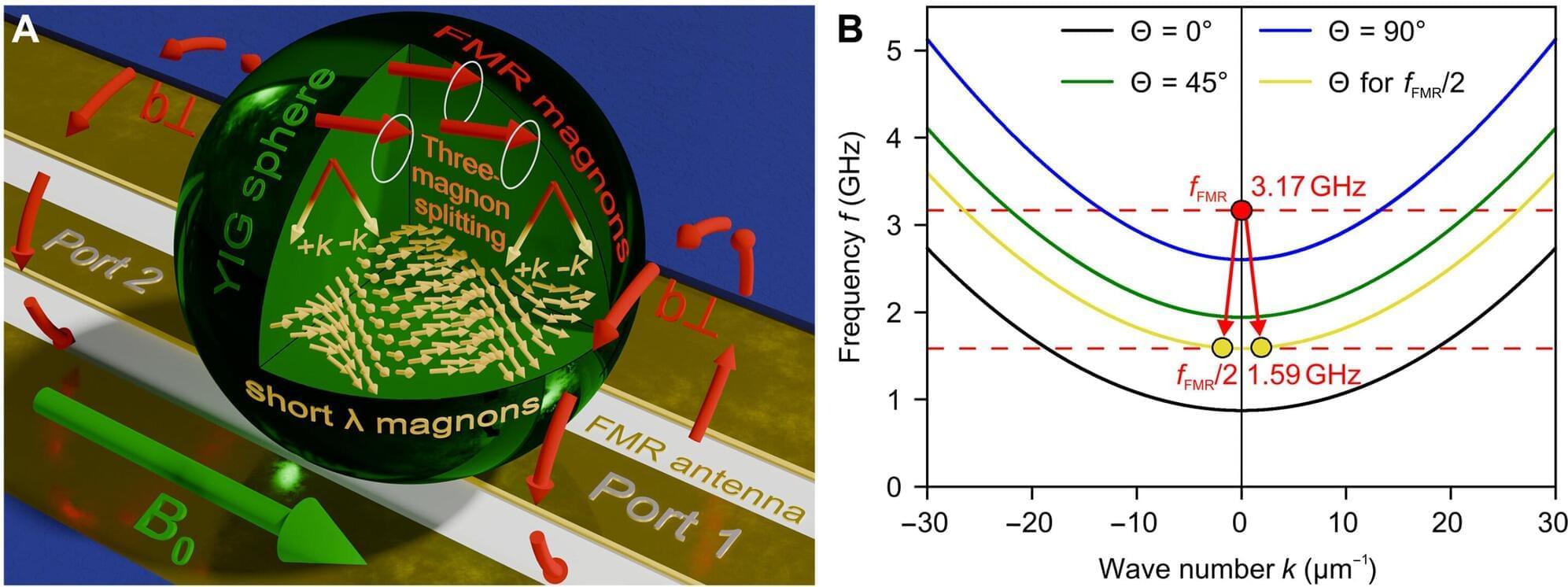
Magnons are tiny waves in magnetization that travel through solid magnetic materials, much like the ripples that spread across a pond when a stone is thrown into it. Unlike photons, which travel through empty space or optical fibers, magnons propagate within a magnetic solid. Their wavelengths can be reduced to the nanometer range, meaning that magnonic circuits could, in principle, fit onto a chip no larger than those found in today’s smartphones. Furthermore, as an excitation of a solid, a magnon naturally couples to numerous other fundamental quasi-particles—phonons, photons and others—making it an ideal building block for hybrid quantum systems and quantum metrology.
Until now, there has been one major obstacle: magnons have had a very short lifetime. This lifetime—the period during which they can reliably carry quantum information—was limited to a few hundred nanoseconds at best. Far too short for any practical quantum computation. The team led by Wiener has now achieved a breakthrough: the physicists were able to measure magnon lifetimes of up to 18 microseconds—almost a hundred times longer than any value observed to date.
In this state, magnons are no longer fleeting signals, but become long-lived, reliable carriers of quantum information, comparable to the superconducting qubits used in today’s leading quantum processors. The study has recently been published in the journal Science Advances.