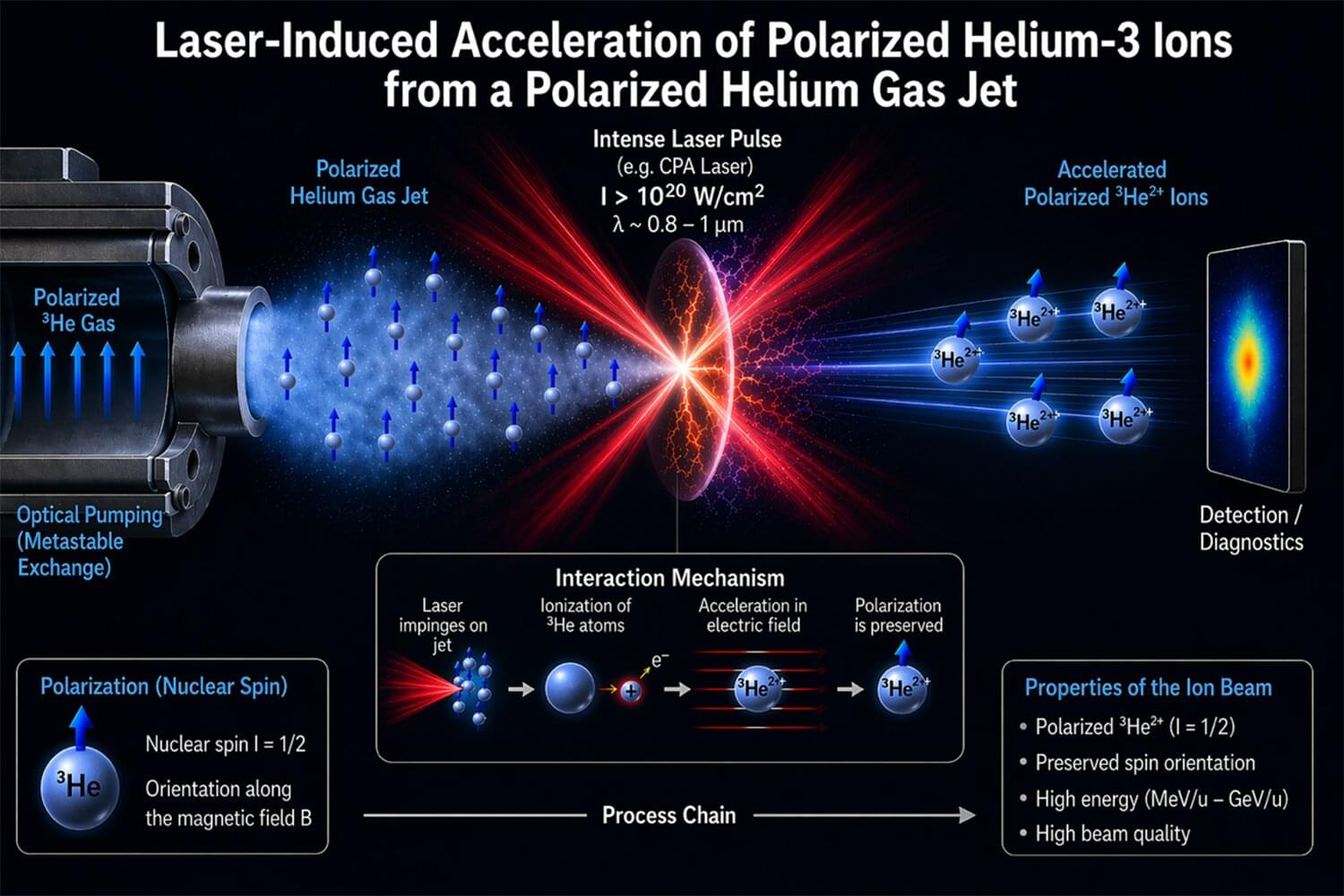
Particle accelerators such as those at the European Organization for Nuclear Research (CERN) in Geneva are typically highly complex large-scale devices. In these ring-shaped facilities, which are often several kilometers in length, magnets and radio-frequency cavities are used to accelerate elementary particles. An alternative approach is now emerging: compact laser–plasma accelerators that can be built and operated at a fraction of the cost. These accelerators can achieve acceleration gradients up to around 1,000 times higher than those of conventional accelerators. Researchers at HHU contributed significantly to this development.
A research team led by Prof. Dr. Markus Büscher, a professor of physics at HHU and group leader at the Peter Grünberg Institute in Jülich, presented the current state of research in a review article in Reports on Progress in Physics. In a separate study published in High Power Laser Science and Engineering, they report on one specific aspect of laser–plasma acceleration, namely whether the polarization—that is to say, the collective spin alignment—of accelerated particles is preserved in laser–plasma accelerators.
Why is this relevant? “Spin alignment is crucial to a range of fundamental scientific questions as it influences the interaction between particles,” explains Professor Büscher. “In controlled nuclear fusion, the reaction probability—and thus ultimately the energy produced in the reactor—increases significantly when the spins of the fusing nuclei, the ‘fusion fuel’ so to speak, are aligned in parallel.”