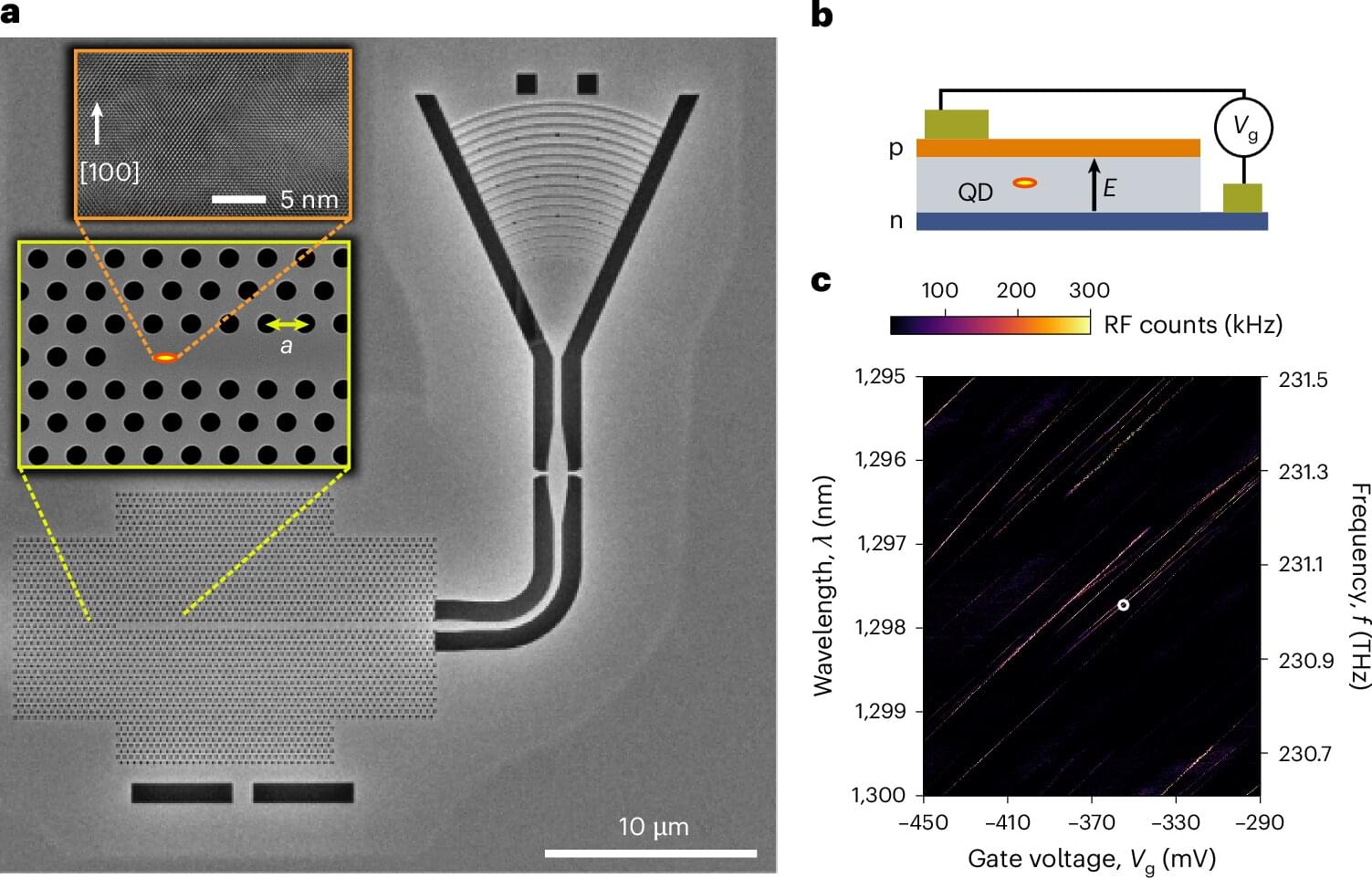
Researchers at the Niels Bohr Institute have broken a longstanding barrier by managing to send single photons—that can’t be copied or split and thus are secure—in the network of optical fibers we already have. This opens up a broad range of applications relying on secure quantum information. The research is published in the journal Nature Nanotechnology.
Quantum dots are unsurpassed in their ability to generate coherent single photons—single particles of light which cannot be split or copied and therefore are secure for quantum communication. So far, the problem was that the best quantum dots only worked around 930 nm wavelengths, which is far short of the telecommunication-compatible wavelengths starting at 1,260 nm. Only these longer wavelengths can be used to distribute the information-carrying photons and it has so far been restricted to sub-optimal platforms.
Now, scientists have managed to create a new type of quantum dot, which exploits the best of both worlds.