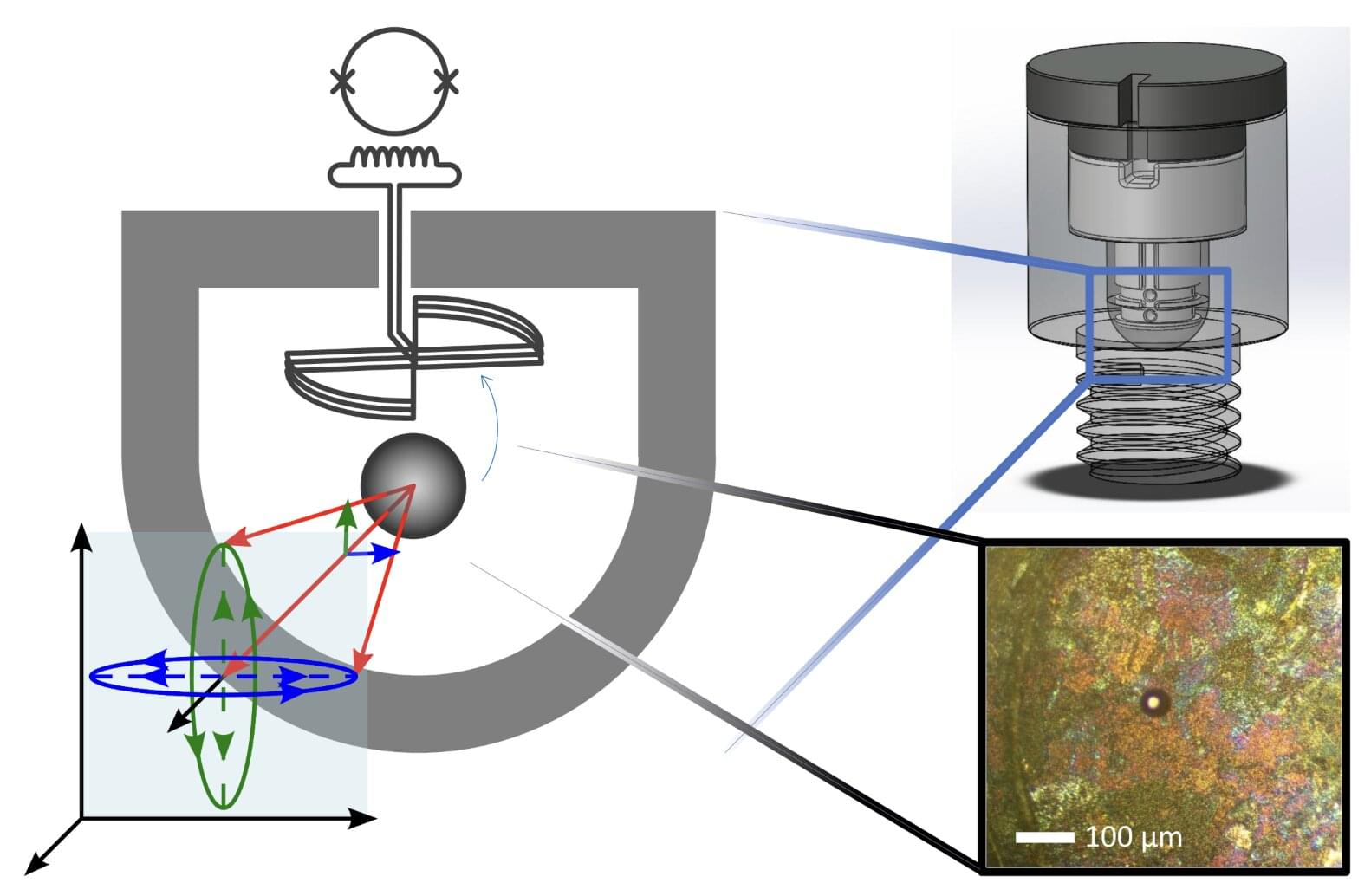
Ferromagnets, such as iron, cobalt, and nickel, are materials with a strong, spontaneous, and permanent magnetic field. Over 150 years ago, the physicist and mathematician James Clerk Maxwell speculated that under specific conditions, non-spinning ferromagnets or electromagnets would behave as gyroscopes, objects that maintain their orientation, typically due to the angular momentum arising from spinning.
Maxwell hypothesized that this unique gyroscopic behavior would arise from the relationship between a ferromagnet’s magnetism and its angular momentum within a specific set-up. While numerous studies tested this prediction, so far it had never been proven experimentally.
Researchers at the Institute of Photonics and Nanotechnology IFN-CNR and the Bruno Kessler Foundation recently observed the effect predicted by Maxwell in a non-spinning and levitated ferromagnetic sphere. Their observations, presented in a paper published in Physical Review Letters, could open new exciting possibilities for the development of quantum technologies and for the collection of highly precise measurements.