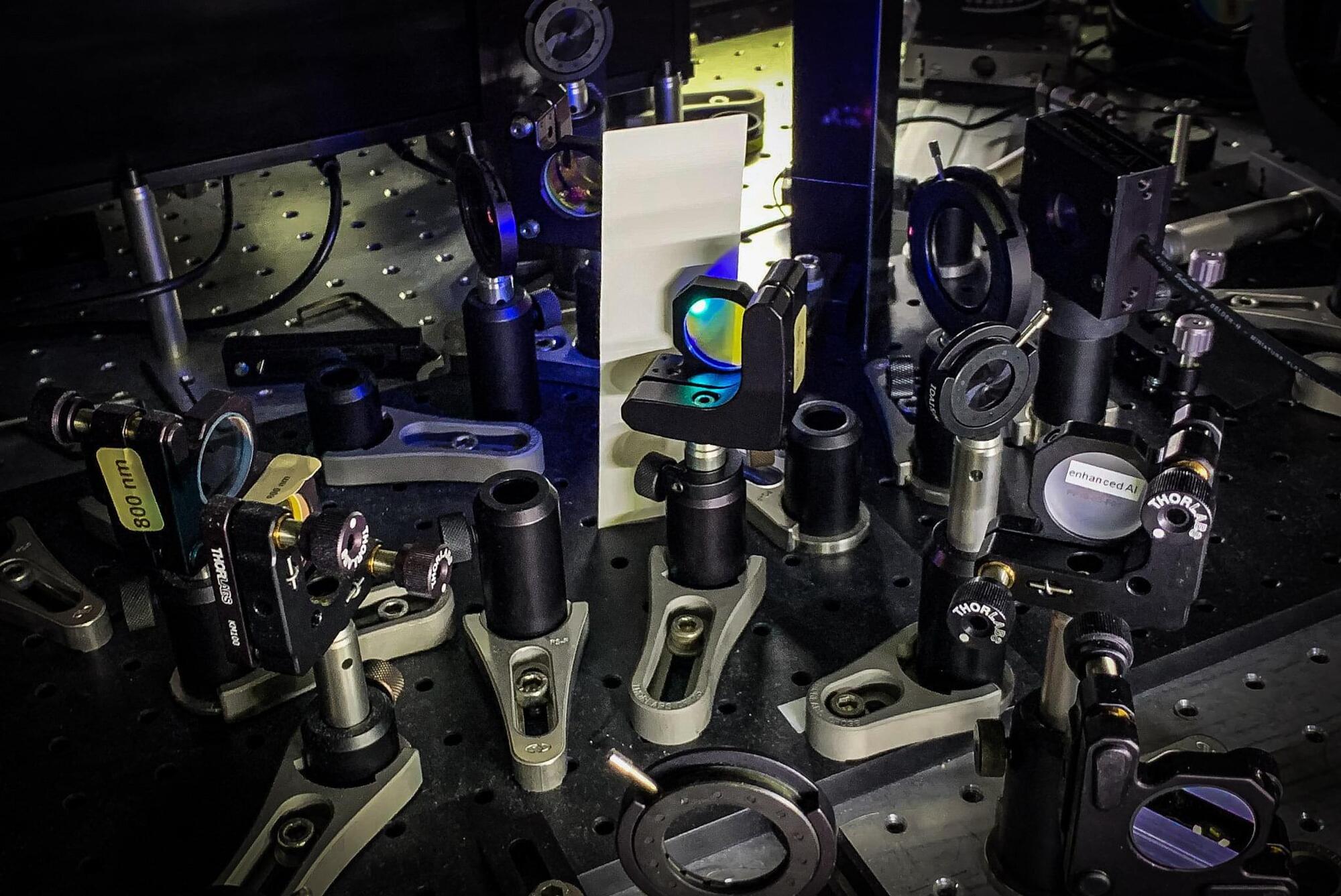
Spintronic devices enable data processing with significantly lower energy consumption. They are based on the interaction between ferromagnetic and antiferromagnetic layers. Now, a team from Freie Universität Berlin, HZB and Uppsala University has succeeded in tracking—separately for each layer—how the magnetic order changes after a short laser pulse has excited the system. The researchers were also able to identify the main cause of the loss of antiferromagnetic order in the oxide layer: The excitation is transported from the hot electrons in the ferromagnetic metal to the spins in the antiferromagnet. The findings are published in the journal Physical Review Letters.
While conventional microelectronics involves the movement of electric charges, spintronics is based on electron spins. Manipulating spins requires less energy than transporting charged particles. Consequently, spintronic components offer the potential for significant energy savings and high processing speeds.
However, future applications will require clock speeds in the terahertz range, which are not yet achievable today. The clock speeds of current spin-based applications are up to a hundred times lower. In order to advance spintronics, a large team at the Transregio Collaborative Research Center CRC/TRR 227 is investigating spin dynamics in solids at atomic resolution and on ultrafast timescales.