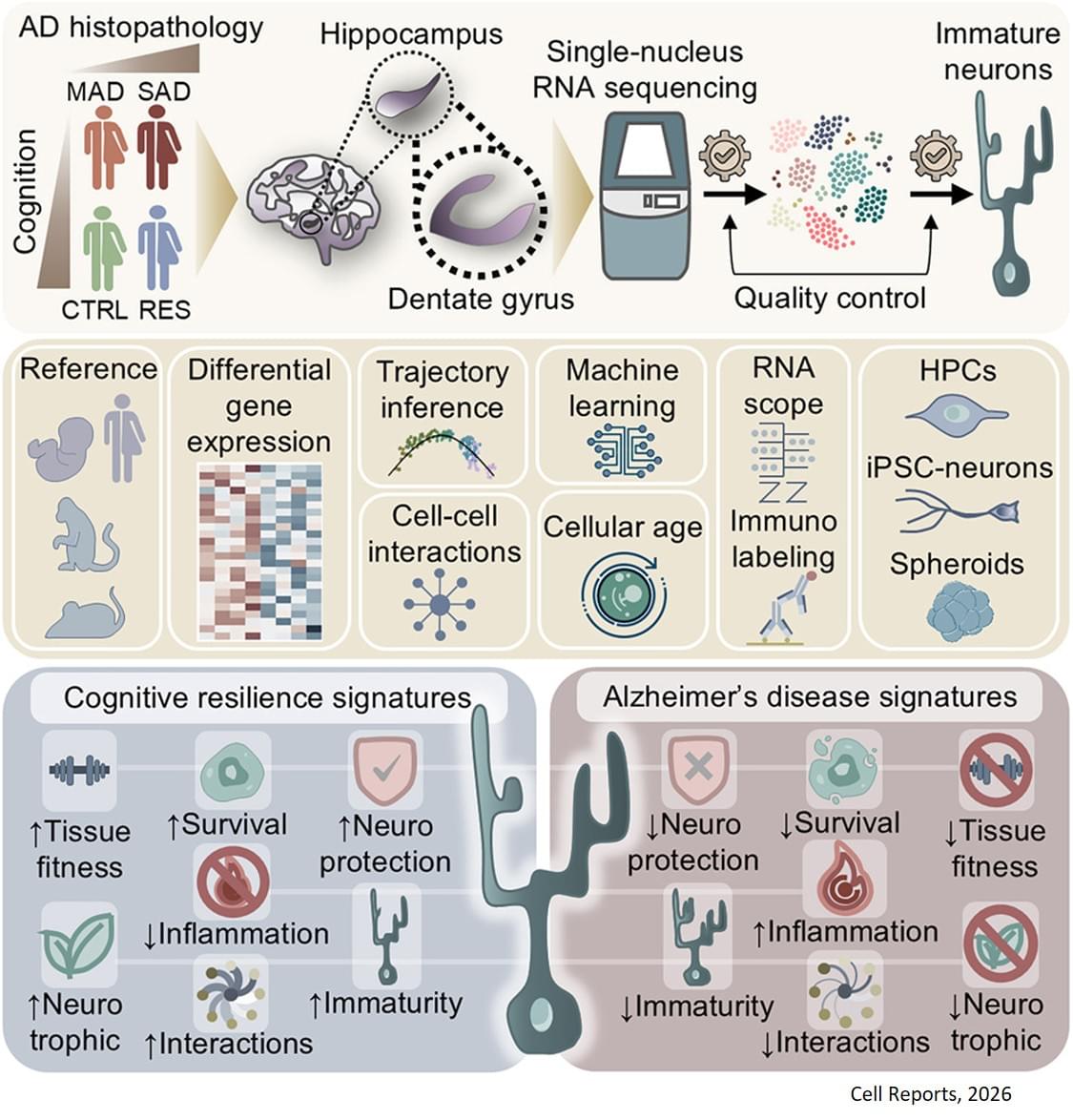
One possible explanation is that resilient brains are better at repairing themselves during Alzheimer’s. “Perhaps they can add new brain cells to a network that is degenerating”, the author says.
This idea is linked to a process called adult neurogenesis, which refers to the birth of new brain cells (neurons) in the adult brain. It has been well-established in other animals, but its existence in humans has been debated for years.
To study this, the team used human brain tissue from the Netherlands Brain Bank, which collects and stores donated brain samples for research. They included brains from control donors with no brain pathology, Alzheimer’s patients, and individuals with Alzheimer’s pathology who remained resilient to developing dementia.
The team focused on a small part of the brain’s memory center, likely one of the few areas where these new brain cells could form. “These cells are extremely rare, so we had to develop new ways to find them,” the author says. “We really zoomed in on the exact spot where we expected them to be.”
The team found what they were looking for: so-called “immature” neurons. These cells resemble young, not fully developed neurons. “Even at an average age of over 80, we still found these immature neurons in all groups,” the author says.
But the biggest surprise came next. While the team had expected to find much more of these cells in the resilient group than in the Alzheimer’s patients, the difference was not as big as expected.
Surprisingly, the team found that the key difference lies in how the immature neurons behave. “In resilient individuals, these cells seem to activate programs that help them survive and cope with damage,” the author says. “We also see lower signals related to inflammation and cell death.”
This points to a more complex story than they thought. “It might not be (only) about replacing lost neurons,” the author explains. “It could be that these cells support the surrounding tissue and help the brain stay functional and ‘youthful’. They may act as a sort of fertilizer in a garden that has started falling apart.”
Some brains resist Alzheimer’s, even when the disease is already present. Researchers have found that this likely depends on how specific brain cells, known as immature neurons, respond to damage caused by the disease. These insights are helping scientists unravel the mystery of cognitive resilience in aging.
Why do some people experience memory loss and cognitive decline as Alzheimer’s builds up in their brain, while others stay mentally sharp? This question lies at the heart of new research into “cognitive resilience”, a phenomenon that is gaining attention in neuroscience.
“Around 30 percent of older adults who develop Alzheimer’s disease never experience its symptoms”, the last author begins. “We really don’t know why. That’s a big mystery, and a very important one.”