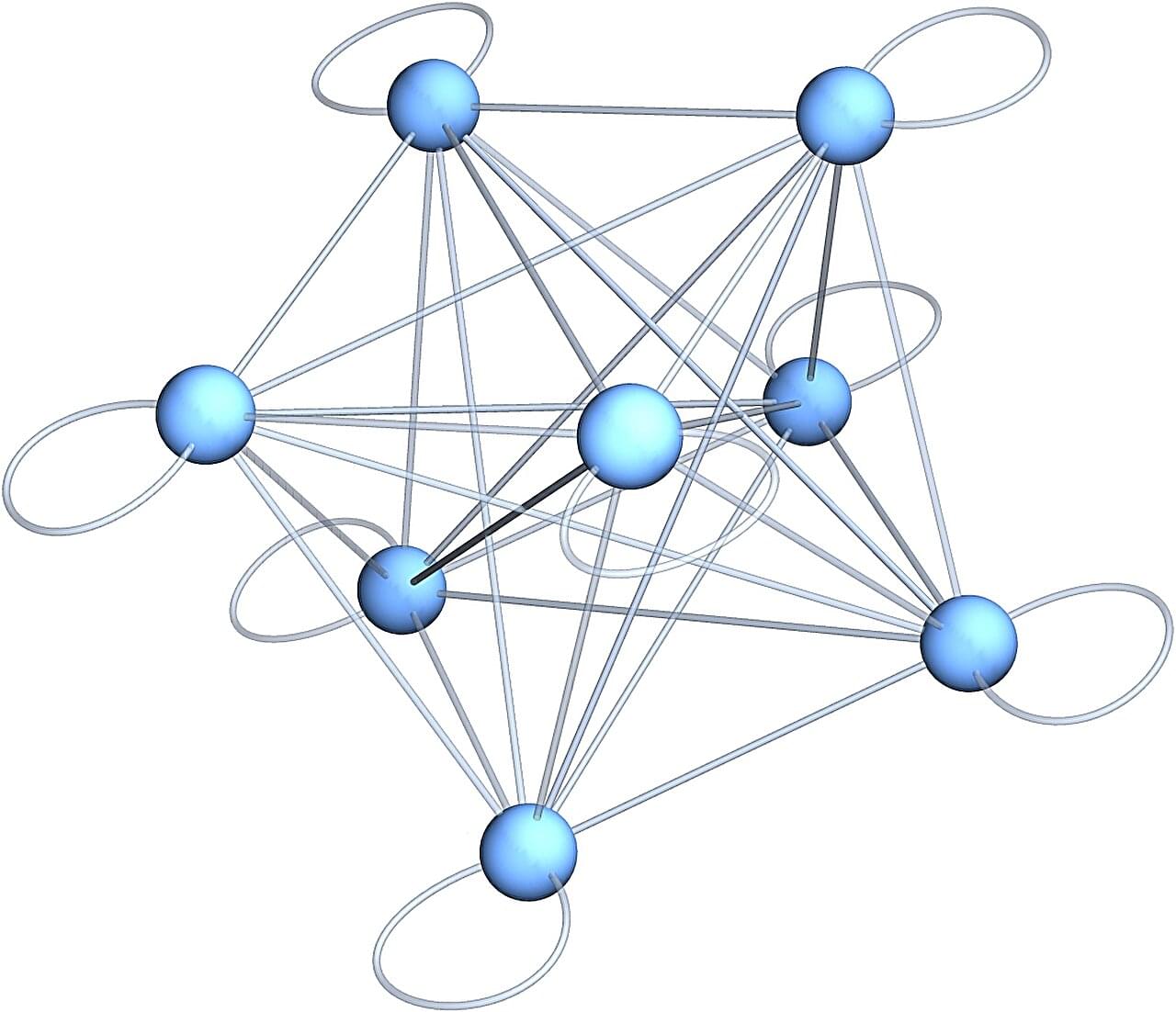
Theoretical physicists in the US have discovered a “speed limit” on the time taken for quantum information to spread through larger systems. Publishing their results in Physical Review Letters, Amit Vikram and colleagues at the University of Maryland have proved for the first time that this minimum time is closely linked with a system’s entropy and temperature, perhaps paving the way for a deeper understanding of quantum information across a wide range of physical settings.
In 1974, Stephen Hawking proposed for the first time that black holes aren’t entirely black. As well as emitting thermal radiation (now known as “Hawking radiation”), they also exhibit thermodynamic properties including temperature and an entropy proportional to their surface area.
Since entropy is a measure of the information carried by a system, this means a black hole’s surface effectively stores a finite number of “qubits”: the quantum equivalent of classical bits, each capable of storing quantum information as a superposition of two states simultaneously. In this way, the black hole’s temperature as described by Hawking governs how these qubits interact and evolve over time.