A rainbow reveals with colors what otherwise remains hidden: light is “refracted” by transparent matter, in this case water droplets. This same physical effect underlies many everyday technologies, like LCD screens and broadband connections based on fiber-optic cables. Light refraction is caused by an interaction between light and the atoms of matter. This brings the light waves slightly out of sync, so to speak. “X-ray light” is “refracted,” too. But the effect is difficult to measure here.
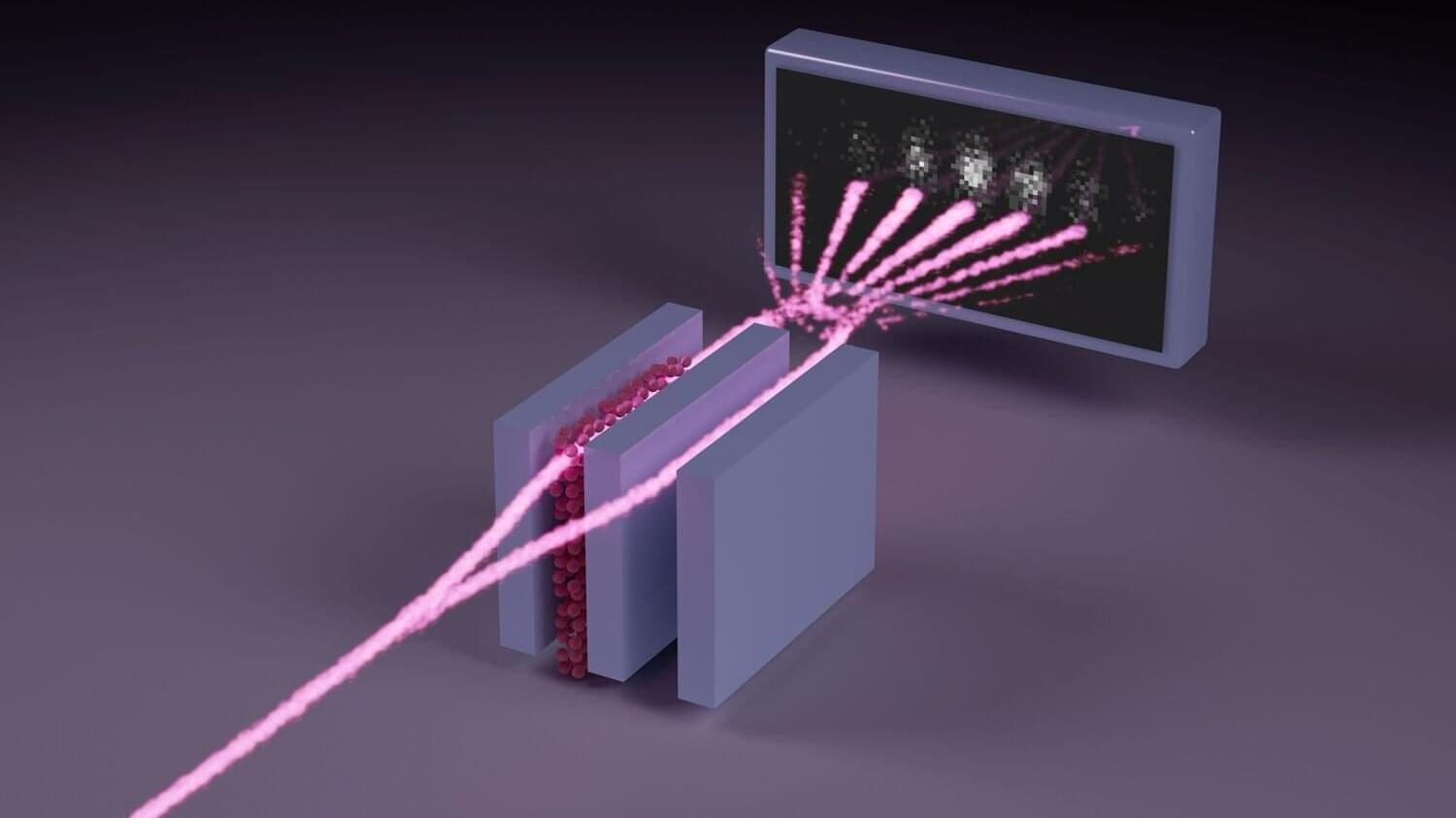
A miniature device now offers a novel approach: Researchers from the Universities of Göttingen and Hamburg, together with partners, have built the world’s smallest X-ray interferometer, to their knowledge. It has enabled them to precisely measure, for the first time, the refraction of X-rays confined to a few nanometers, and to deduce how they interact with atomic nuclei. The study was published in the journal Nature Photonics.
The new X-ray interferometer is based on the famous double-slit experiment, which Nobel laureate Richard Feynman said “has in it the heart of quantum mechanics.”