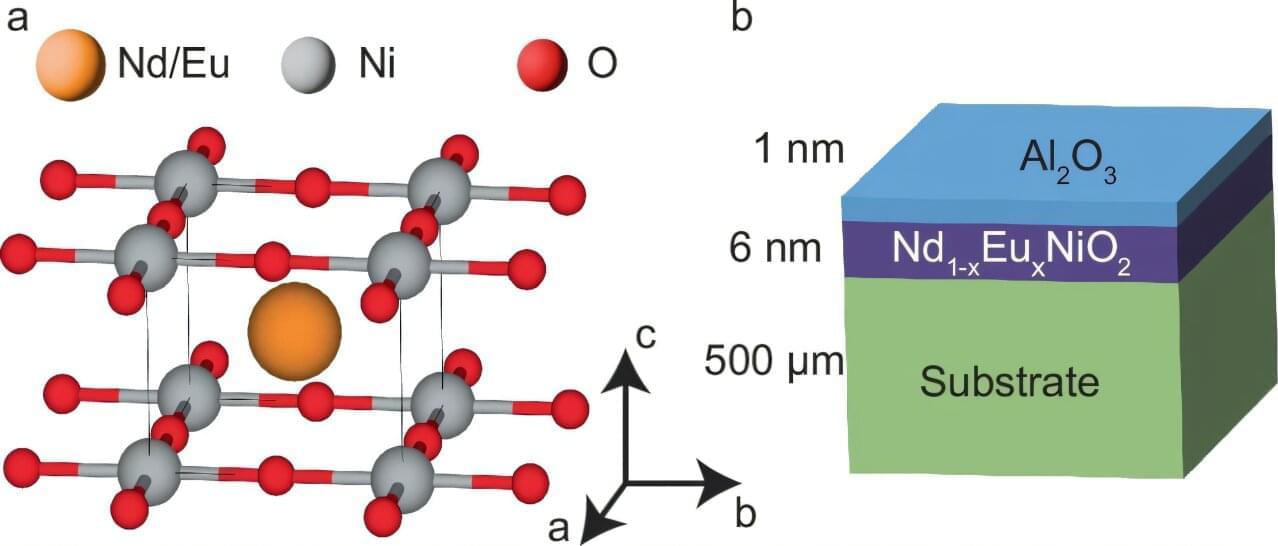
Discovered in 2019, the material known as nickelates has intrigued researchers for its potential to become a superconductor at elevated temperatures—a property that could significantly advance such fields as quantum science and energy transmission. However, it’s a very unstable material and difficult to work with. But the lab of Professor Charles Ahn has developed a method that could enhance superconductivity in these materials. The results are published in Nature Communications.
With their ability to conduct electricity with no resistance, superconductors are a key component to quantum computing, medical imaging, and a number of other fields. A group of copper-oxide compounds known as cuprates have long been central to the study of high-temperature superconductivity (“high temperature” is a relative term—they still need to be kept in very cold environments). Nickelates are especially exciting because they share some of cuprates’ key electronic features while offering a new platform for materials design and tuning.
Enter nickelates, a material with many similarities to cuprates, but with the potential to eventually become even more useful to scientists. Dung Vu, a postdoctoral associate who led the study, noted that synthesizing nickelate thin films is “notoriously difficult.” The Ahn lab is one of the few in the world with the ability to do so.