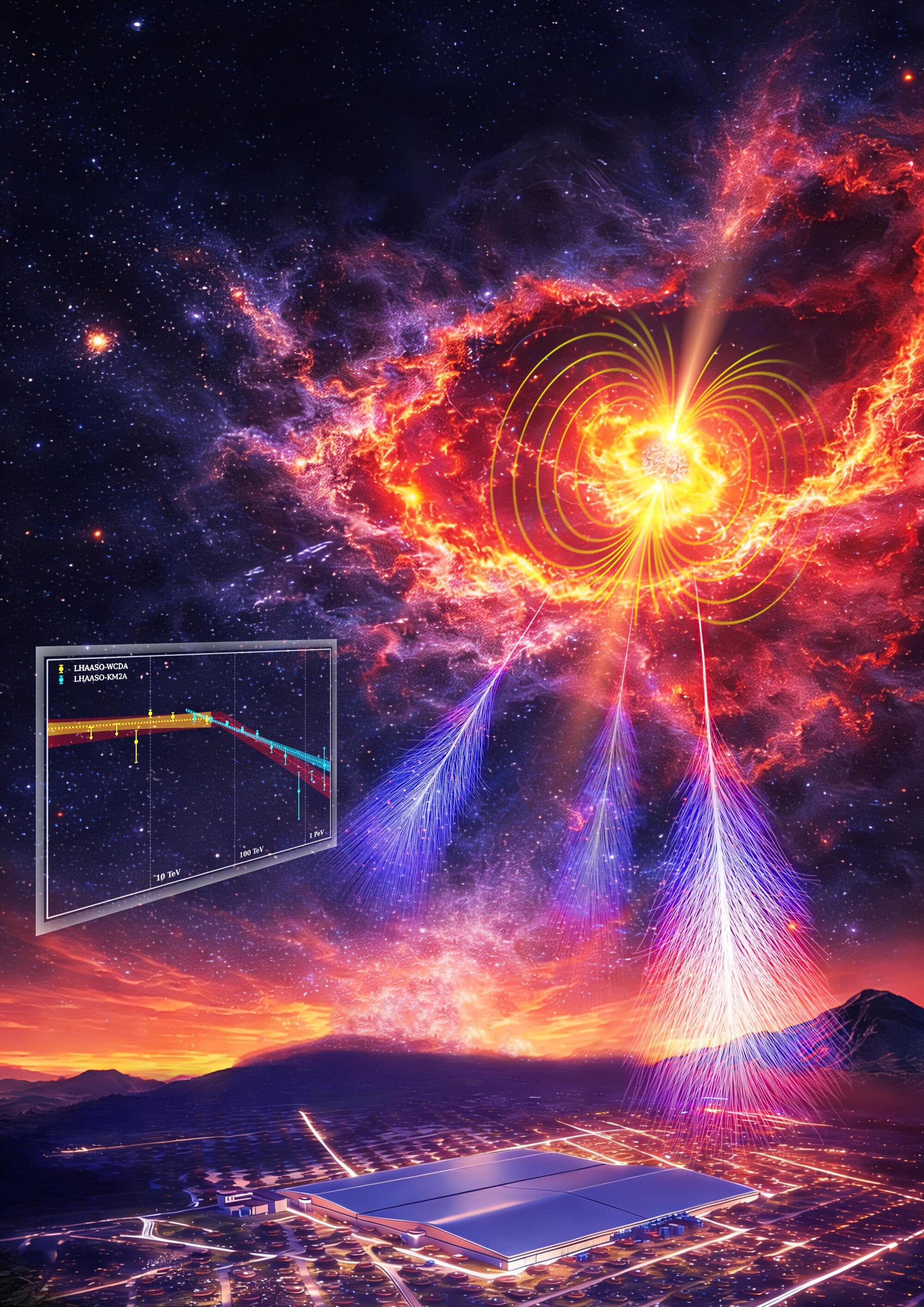
The Large High Altitude Air Shower Observatory (LHAASO) has detected PeV (1015 eV) gamma-ray emission from a pulsar wind nebula powered by PSR J1849-0001 in the constellation Aquila, marking the discovery of a new PeVatron and posing a challenge to the classical theory of particle acceleration in pulsar wind nebulae.
This discovery is important because the calculated particle acceleration efficiency of this celestial structure approaches or even exceeds the theoretical limits allowed under ideal magnetohydrodynamic conditions.
This study, published in Nature Astronomy, was conducted by Prof. Liu Ruoyu, Dr. Wang Kai, and doctoral student Tong Chaonan from Nanjing University, Prof. Chen Songzhan and Assoc. Prof. Wang Lingyu from the Institute of High Energy Physics of the Chinese Academy of Sciences, and their collaborators.