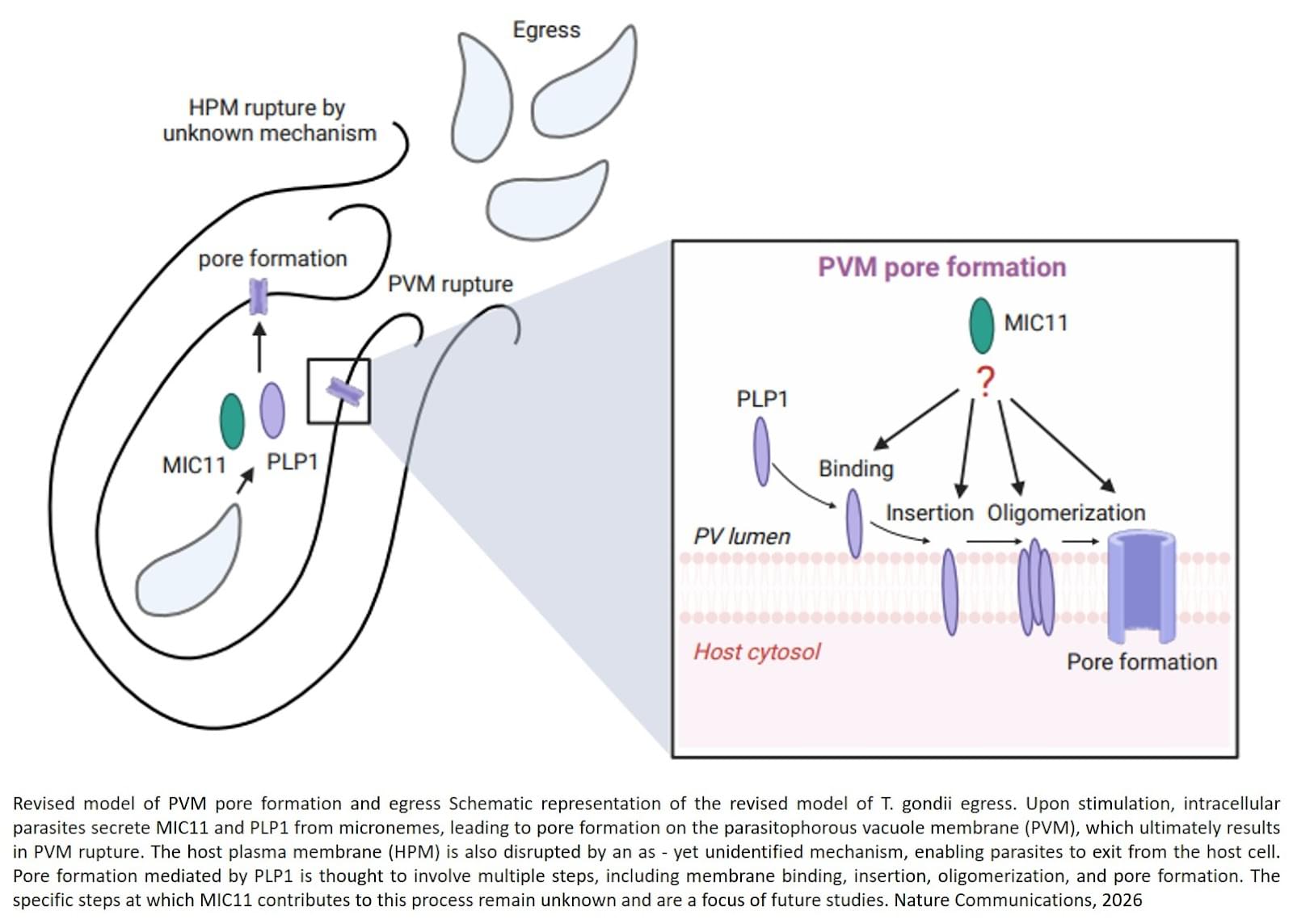
After infecting host cells and reproducing, the parasite life cycle requires them to egress so that they can move to the next host. Past studies on the genes required for this process have been conducted but show conflicting results.
The methodology of past studies often involved opening the host cells during the screening process. Consequently, researchers were unable to reliably identify when mutations prevent parasites from egressing.
To avoid the same limitations, the team used an in vivo approach to screen for essential genes instead.
“Our in vivo screen, based on CRISPR, identified for the first time that the MIC11 gene is essential for host cell membrane permeabilization and parasite egress.” Explains the lead author.
Further tests demonstrated that deleting the MIC11 gene led the parasites to be unable to rupture the host cell membrane. By incapacitating parasites in this way, they could no longer exit the host cells, majorly disrupting the parasite life cycle.
“We also found evidence that MIC11 interacts with PLP1, providing further evidence of MIC11’s crucial role,” explains the senior author. “PLP1 is another parasite protein that was already known to be essential for egress.” ScienceMission sciencenewshighlights.
Parasites are a major global health problem, underlying many human diseases worldwide. For example, Plasmodium falciparum, the parasite responsible for malaria, plays a well-established; however, its complex life cycle is not yet fully understood. This includes how parasites exit the infected host cells, known as egress.
However, a research team has elucidated the exit process after identifying an essential gene, MIC11. To clearly explain egress, the behaviors of Toxoplasma gondii – known to cause toxoplasmosis and neurological symptoms – were assessed. The findings of the research are due to be published in Nature Communications.
The parasite life cycle moves through multiple host organisms, starting from the primary, or definitive, host. For T. gondii, the definitive hosts are felines, both domestic and wild, as the parasite can sexually reproduce within their intestines. Although T. gondii can also infect intermediate hosts for asexual reproduction, which includes almost all warm-blooded mammals.