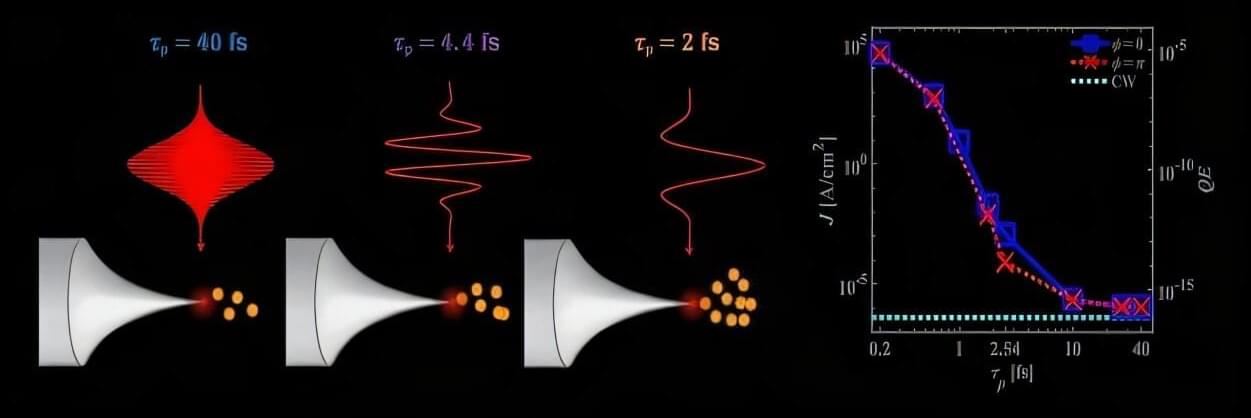
A new theoretical study finds shorter laser pulses achieve higher quantum efficiency for photoemission from a solid surface without increasing power or intensity. Using light to knock electrons loose from a surface—known as photoemission—may soon be achievable more easily in smaller labs with smaller lasers. Shortening the length of a laser pulse can increase the emitted electrons by several orders of magnitude without increasing the laser intensity or power, according to a University of Michigan Engineering study.
The study is published in Physical Review Research.
Efficient, low-power photoemission could make particle acceleration and high-resolution imaging techniques to visualize cells and atoms more accessible. It could also help researchers develop lightwave electronics, which use light to move charge carriers, for ultrafast computing.