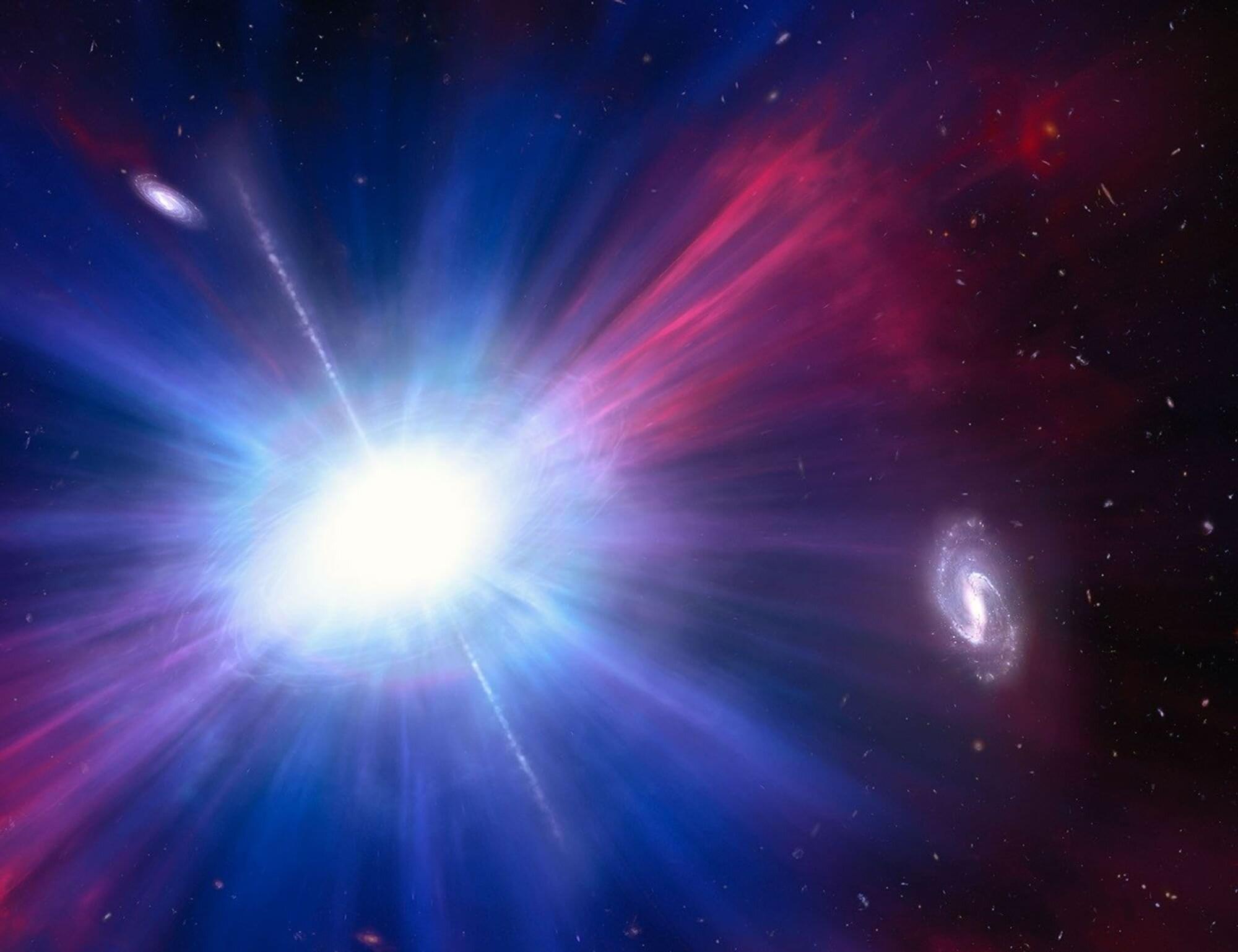
Luminous fast blue optical transients (LFBOTs) are among the universe’s brightest and fastest explosions but their origin is not completely understood. A new study takes a closer look at the galaxies they occur in, offering two important clues about their nature. A paper outlining these results was uploaded to the preprint server arXiv on March 24.
LFBOTs are called cow-like events, nicknamed after the first member of this class—AT2018cow—discovered in 2018. They are extremely bright explosions whose brightness peaks within a week and fades to half its peak value in the following week. Their peak brightness is typically greater than 1043 erg per second at optical wavelengths. This is comparable with that of superluminous supernovae, which take a few weeks to months to peak and are generally 10 to 100 times brighter than normal supernovae.
Moreover, LFBOTs’ light curve—a graph that shows changes in their brightness over time—cannot be explained by the decay of nickel-56, which is a common energy source for normal and core-collapse supernovae. There are several theories for their origins; however, there is a lack of consensus.