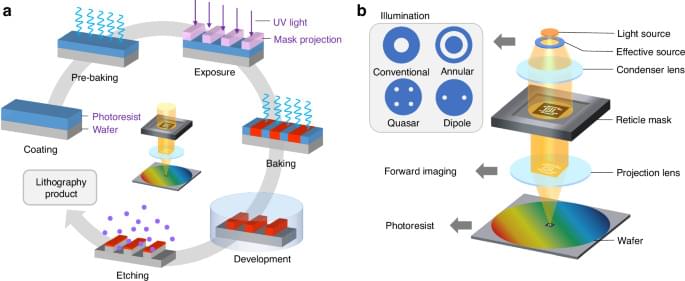
Inverse lithography takes a radically different approach. Instead of starting with the desired circuit pattern and tweaking it to compensate for optical distortions, ILT works backwards. It asks: “What mask pattern would produce the exact shape we want after the light does its distorting work?” It’s like designing a funhouse mirror that makes your reflection look perfectly normal.
What’s particularly elegant are the “model-driven deep learning” approaches, which combine the physics of how light actually behaves with AI’s pattern-recognition abilities. Rather than making the AI learn optics from scratch, these hybrid methods embed the known laws of physics into the learning process, creating solutions that are both fast and physically accurate.
Yang, Y., Liu, K., Gao, Y. et al. Light Sci Appl 14, 250 (2025). https://doi.org/10.1038/s41377-025-01923-w.