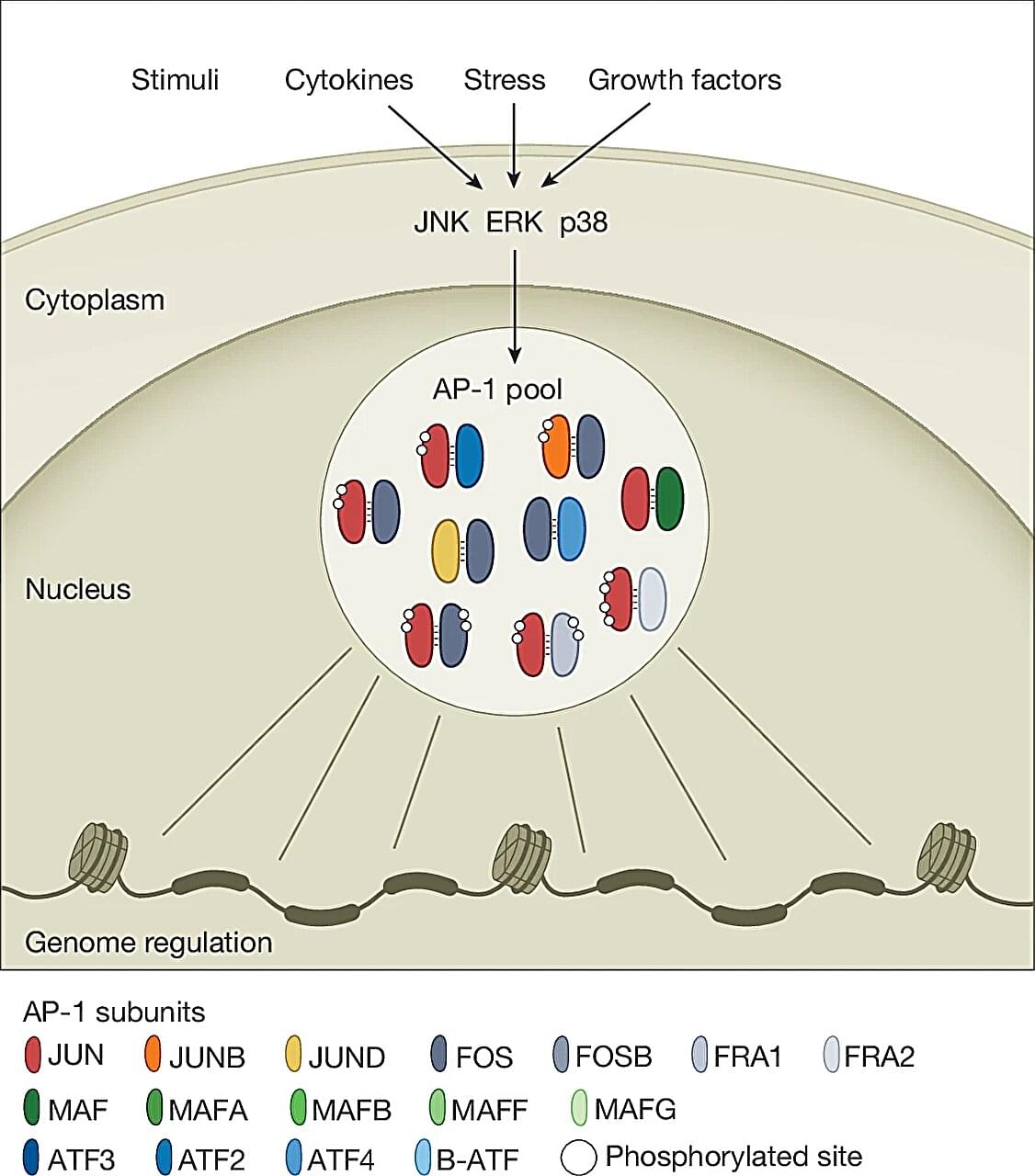
Researchers at NYU Langone Health propose a model that could explain how cancer cells adapt to environmental stress, an approach that may lead to new therapies. Published online April 15 as the cover story of the journal Nature, the perspective article centers on a family of proteins called AP-1, which are quickly activated in cells in response to stressful situations—like being exposed to chemotherapy.
While AP-1 proteins have been studied for many decades, the authors propose they are part of a previously overlooked molecular mechanism in which cells survive by learning to rewire their circuitry. This process depends not on permanent changes to a cell’s DNA code, but rather on the cell’s ability to turn genes on or off, and then “remember” the changes that improve its survival chances.
The work suggests that cancer cells use this plasticity to explore gene expression patterns until they find a combination that helps them survive. Once a successful survival state is discovered, it can be locked in and passed down to future cell generations, leading to drug-resistant tumors.