Beginning in the 1950s, silicon transformed the electronics industry by enabling smaller and faster devices that could be reliably manufactured at scale. More than six decades later, silicon-based semiconductors remain at the heart of many modern technologies, including so-called “classical” computers.
In pursuit of new quantum technologies, scientists and engineers have turned to specialized materials for building qubits—the fundamental components of quantum systems. For example, many qubits are made from superconducting materials deposited on sapphire substrates. But transitioning from laboratory demonstrations to scalable systems will require scientific and manufacturing infrastructure capable of supporting robust and reliable qubit fabrication.
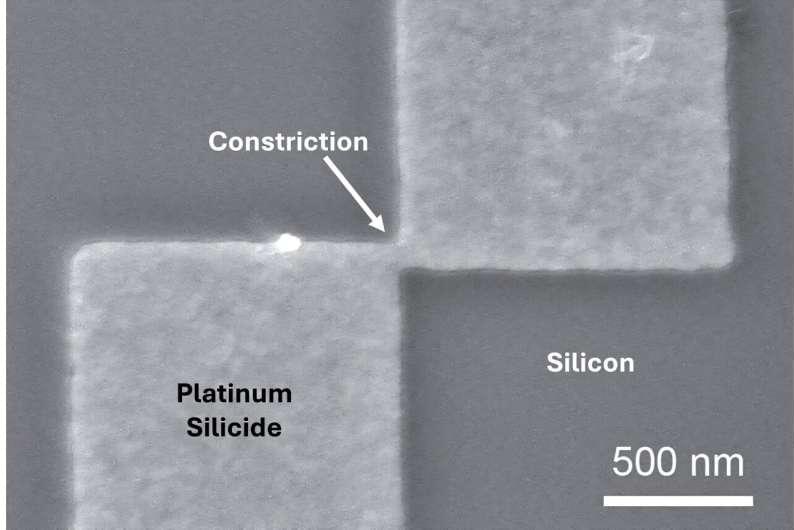
Marking a milestone toward bridging that gap, researchers at the U.S. Department of Energy’s (DOE) Brookhaven National Laboratory have built superconducting quantum interference devices (SQUIDs) using a silicon-compatible class of materials called transition metal silicides. The research was conducted as part of the Co-design Center for Quantum Advantage (C2QA), a recently renewed National Quantum Information Science Research Center led by Brookhaven Lab.