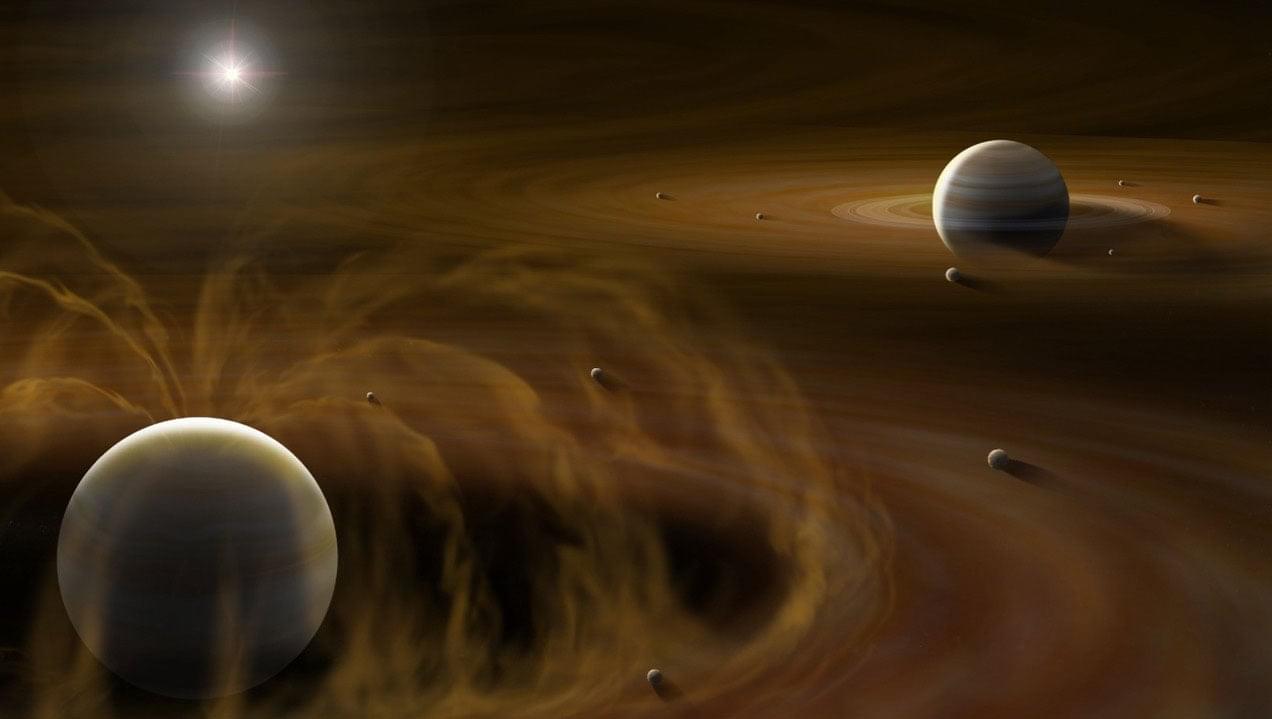
Jupiter and Saturn, the two largest planets in our Solar System, also host the most extensive systems of moons. Jupiter is currently known to have more than 100 moons, while Saturn, along with its prominent ring system, has more than 280.
Despite these large numbers, their moon systems are very different. Jupiter has four major moons, including Ganymede, the largest moon in the Solar System. Saturn, on the other hand, is dominated by a single standout moon, Titan, which ranks as the second largest.
Because both planets are gas giants, scientists have long tried to understand why their satellite systems developed so differently. Existing theories of moon formation offer some explanations, but recent research on stellar magnetic fields suggests those ideas may need revision. One key question involves magnetic accretion and whether an inner cavity can form in Jupiter’s circumplanetary disk, the accumulation of material orbiting a planet from which satellites may form.