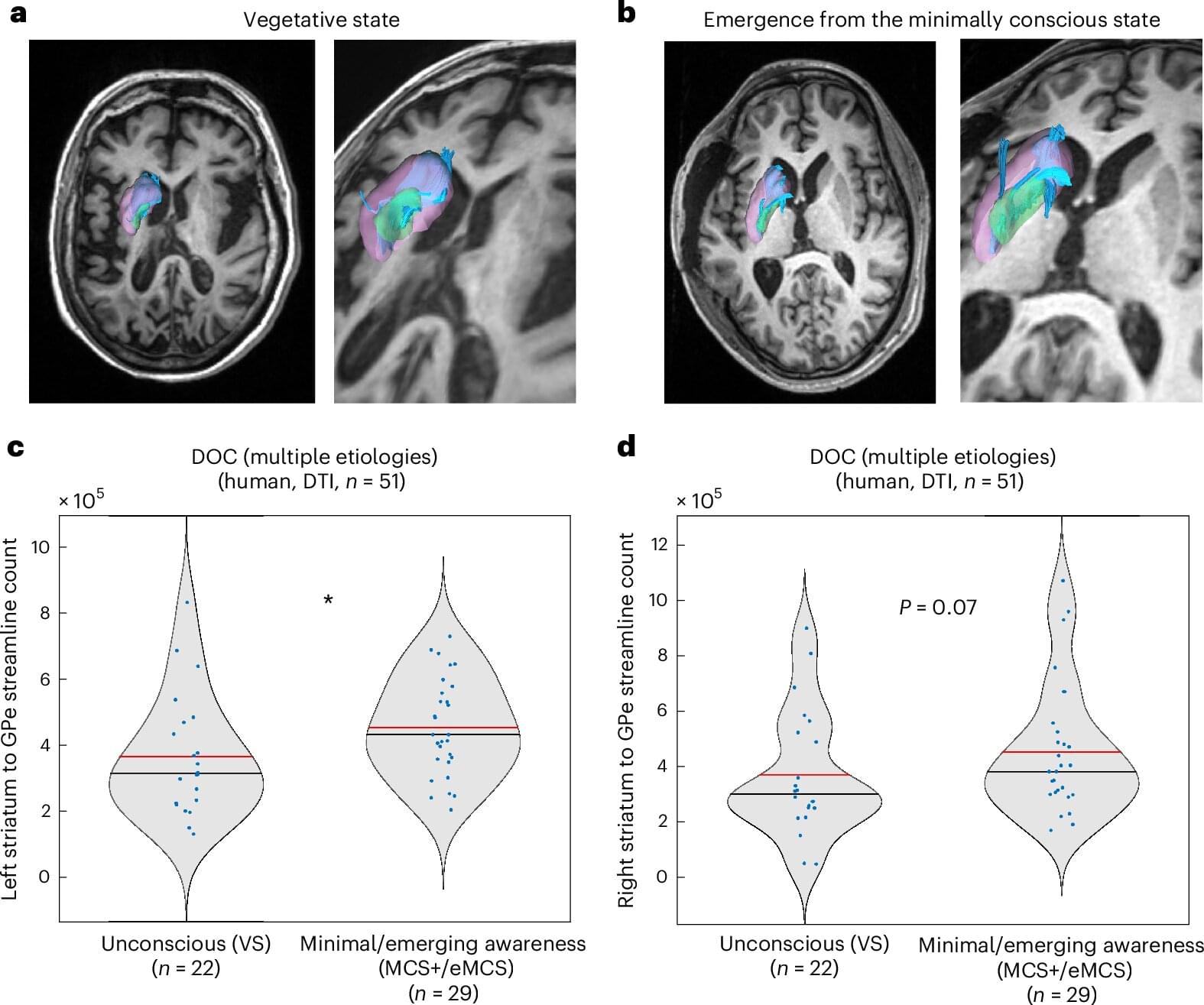
Consciousness, and the ways in which it can become impaired after certain brain injuries, are not well understood, making disorders of consciousness (DOC), like coma, vegetative states and minimally conscious states difficult to treat. But a new study, published in Nature Neuroscience, indicates that AI might be able to help researchers gain some traction with this problem. The research team involved in the new study has developed an adversarial AI framework to help them determine what exactly is going on in states of reduced consciousness and how to approach a solution.
To better understand the mechanisms behind impaired consciousness, the researchers developed two types of AI models and had them play a kind of game where one model determined different levels of consciousness based on EEGs simulated to look like those of real unconscious and conscious brains. The AI agents guessing consciousness levels, called deep convolutional neural networks (DCNNs), were first trained on 680,000 ten-second recordings of brain activity from conscious and unconscious humans, monkeys, bats and rats to detect which neural signals related to differing levels of consciousness. The AI showing EEG data was a biologically plausible simulation of the human brain.
“To decode consciousness from these signals, we trained three separate DCNNs, each specialized for a different brain region, to output a continuous score from 0 (unconscious) to 1 (fully conscious): a cortical consciousness detector (ctx-DCNN), a thalamic consciousness detector (th-DCNN) and a pallidal consciousness detector (pal-DCNN). The ctx-DCNN was trained on continuous consciousness levels derived from clinical scales (GCS and CRS-R), enabling it to recognize graded states of consciousness,” the study authors explain.
It’s becoming clear that with all the brain and consciousness theories out there, the proof will be in the pudding. By this I mean, can any particular theory be used to create a human adult level conscious machine. My bet is on the late Gerald Edelman’s Extended Theory of Neuronal Group Selection. The lead group in robotics based on this theory is the Neurorobotics Lab at UC at Irvine. Dr. Edelman distinguished between primary consciousness, which came first in evolution, and that humans share with other conscious animals, and higher order consciousness, which came to only humans with the acquisition of language. A machine with only primary consciousness will probably have to come first.
What I find special about the TNGS is the Darwin series of automata created at the Neurosciences Institute by Dr. Edelman and his colleagues in the 1990’s and 2000’s. These machines perform in the real world, not in a restricted simulated world, and display convincing physical behavior indicative of higher psychological functions necessary for consciousness, such as perceptual categorization, memory, and learning. They are based on realistic models of the parts of the biological brain that the theory claims subserve these functions. The extended TNGS allows for the emergence of consciousness based only on further evolutionary development of the brain areas responsible for these functions, in a parsimonious way. No other research I’ve encountered is anywhere near as convincing.
I post because on almost every video and article about the brain and consciousness that I encounter, the attitude seems to be that we still know next to nothing about how the brain and consciousness work; that there’s lots of data but no unifying theory. I believe the extended TNGS is that theory. My motivation is to keep that theory in front of the public. And obviously, I consider it the route to a truly conscious machine, primary and higher-order.
My advice to people who want to create a conscious machine is to seriously ground themselves in the extended TNGS and the Darwin automata first, and proceed from there, by applying to Jeff Krichmar’s lab at UC Irvine, possibly. Dr. Edelman’s roadmap to a conscious machine is at https://arxiv.org/abs/2105.10461, and here is a video of Jeff Krichmar talking about some of the Darwin automata, https://www.youtube.com/watch?v=J7Uh9phc1Ow