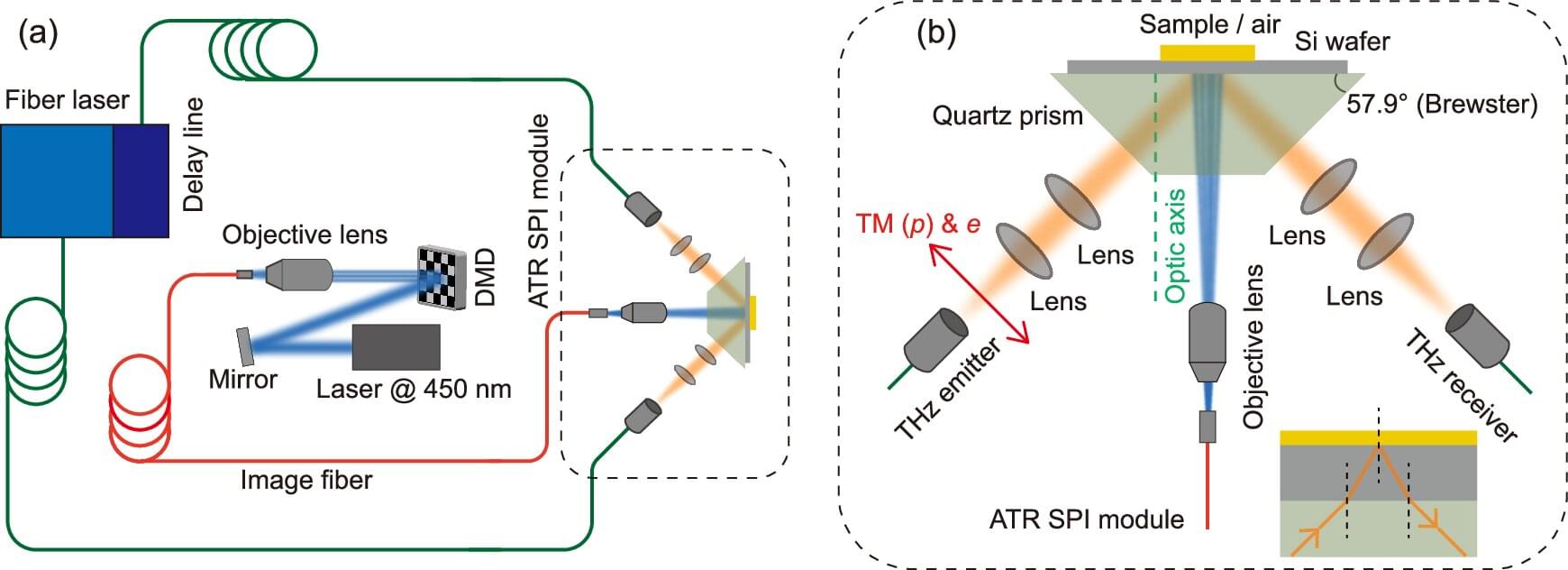
Scientists at the University of Warwick and University of Exeter have developed a fully fiber-coupled terahertz (THz) imaging system that significantly improves the speed, resolution, and clinical practicality of terahertz imaging. The study, published in Nature Communications, demonstrates a high-throughput, compact platform that overcomes key barriers limiting current THz systems—bringing real-time, non-invasive tissue imaging closer to routine clinical use.
“Terahertz imaging has shown immense promise for biomedical diagnostics, but its translation into real-world clinical tools has been hindered by bulky systems and slow acquisition speeds,” said Professor Emma MacPherson, Department of Physics, University of Warwick. “It’s an exciting breakthrough as the fiber coupling means that the system can be flexible and compact, meaning it can function as a handheld device or be integrated with a robot.”
Terahertz waves sit between microwaves and infrared light on the electromagnetic spectrum. Crucially, they are non-ionizing (meaning they do not carry the risks associated with X-rays) and are highly sensitive to water content, which helps reveal differences between healthy and diseased tissue. Despite this promise, most existing terahertz imaging systems are bulky and slow, limiting their use outside specialist labs.