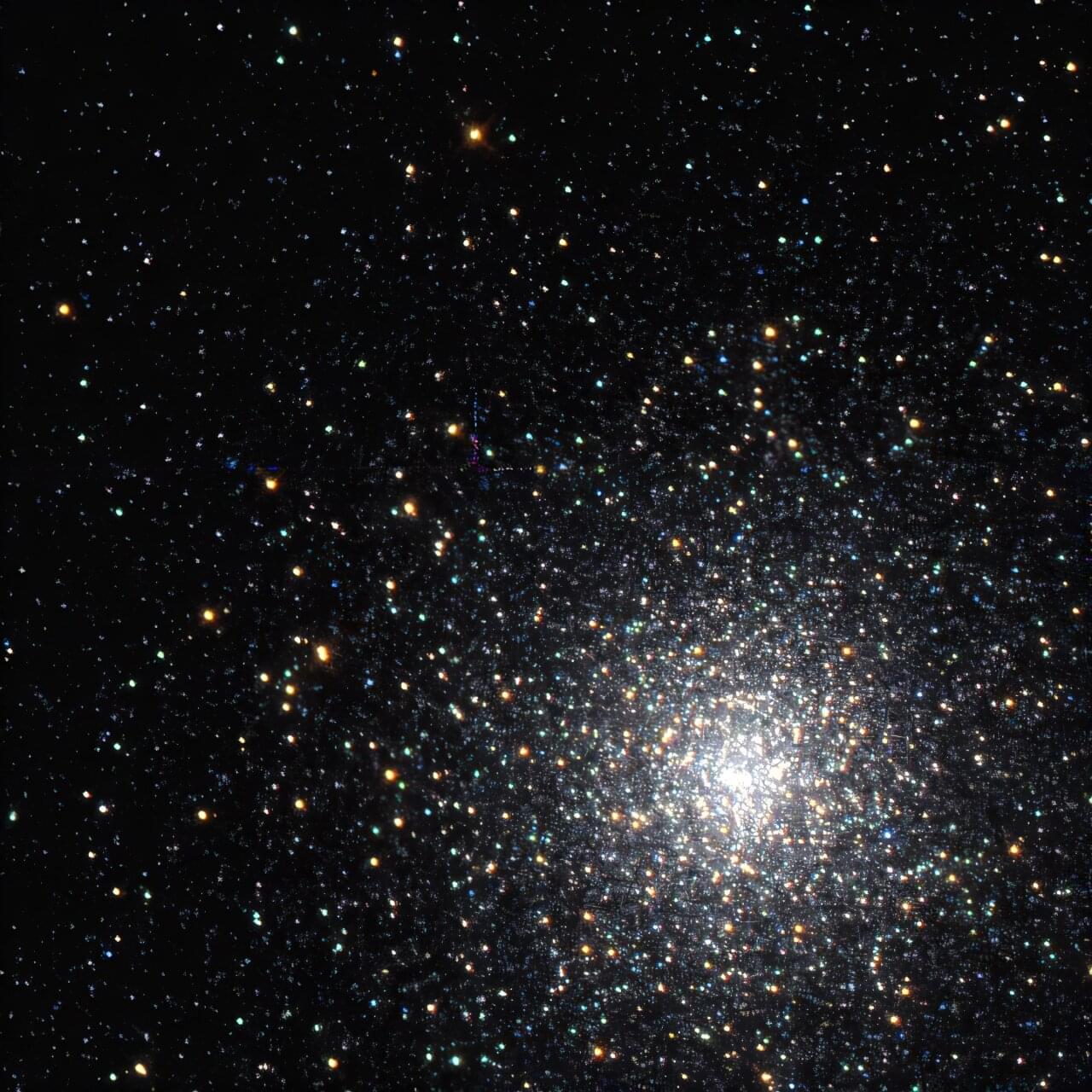
Using data from the Magellan Clay telescope and the Canada-France-Hawaii Telescope (CFHT), astronomers have investigated a galactic globular cluster known as NGC 5824. Results of the new study, available in a paper published March 5 on the arXiv pre-print server, suggest that the cluster is embedded in a dark matter halo.
NGC 5,824 is an old globular cluster (GC) located some 104,000 light years away in the Milky Way’s outer halo. It has a mass of about 1 million solar masses, an age of 12.8 billion years and is the second brightest globular cluster of the outer halo clusters. NGC 5,824 is known to have a diffuse stellar envelope that extends beyond its tidal radius and symmetrically surrounds the cluster.
Given that the origin of the stars in this envelope and whether they remain gravitationally bound to the cluster center is still unclear, a team of astronomers led by Paula B. Díaz of the University of Chile decided to investigate NGC 5,824 by analyzing the data from the survey of the Milky Way outer halo satellites, based on the images acquired by CFHT and the Magellan Clay telescope. The study was complemented by data from ESA’s Gaia satellite.