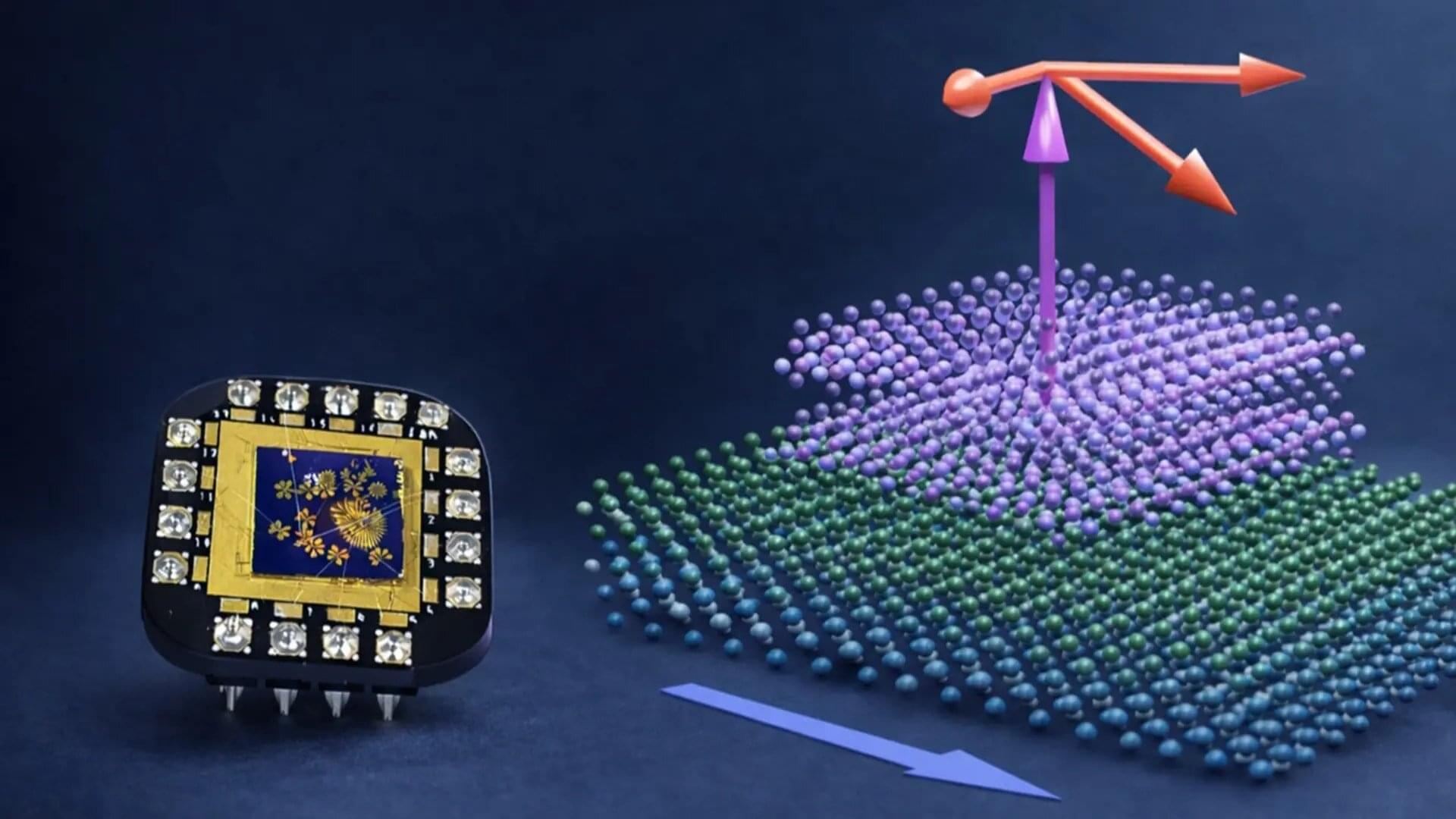
Spintronics—a technology that harnesses the electron’s magnetic quantum states to carry information—could pave the way for a new generation of ultra-energy-efficient electronics. Yet a major challenge has been the ability to control these delicate quantum properties with sufficient precision for practical applications. By combining different quantum materials, researchers at Chalmers University of Technology have now taken a decisive step forward, achieving unprecedented control over spin phenomena. The advance opens the door to next-generation low-power data processing and memory technologies.
Data centers, cloud services, AI and connected systems account for a rapidly growing share of global energy consumption. In the quest for new, more energy-efficient technological solutions, spin electronics, or spintronics, has proven to be a new and promising approach. Instead of relying solely on the movement of electric charge, spintronics use magnetic states to carry information. More specifically, it takes advantage of a quantum property of electrons known as spin, which makes electrons behave like tiny magnets.
“Just like a compass needle, an electron’s spin can point in one of two directions—up or down. These two directions can be used to represent digital information, in the same way today’s electronics use 0s and 1s,” explains Saroj Dash, Professor of Quantum Device Physics at Chalmers University of Technology.