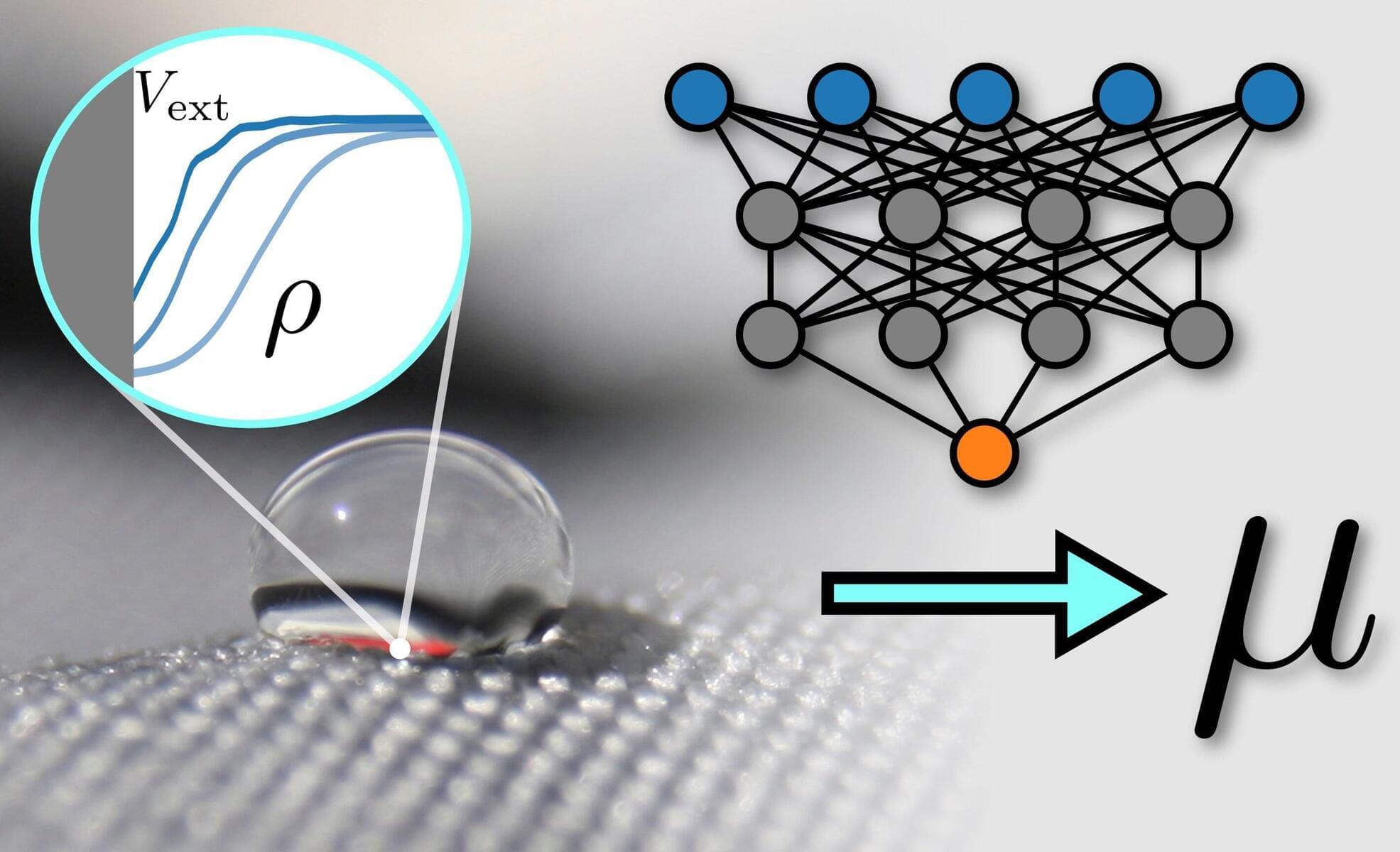
Researchers at the University of Bayreuth have developed a method using artificial intelligence that can significantly speed up the calculation of liquid properties. The AI approach predicts the chemical potential—an indispensable quantity for describing liquids in thermodynamic equilibrium. The researchers present their findings in a new study published in Physical Review Letters.
Many common AI methods are based on the principle of supervised machine learning: a model—for instance, a neural network—is specifically trained to predict a particular target quantity directly. One example that illustrates this approach is image recognition, where the AI system is shown numerous images in which it is known whether or not a cat is depicted. On this basis, the system learns to identify cats in new, previously unseen images.
“However, such a direct approach is difficult in the case of the chemical potential, because determining it usually requires computationally expensive algorithms,” says Prof. Dr. Matthias Schmidt, Chair of Theoretical Physics II at the University of Bayreuth. He and his research associate Dr. Florian Sammüller address this challenge with their newly developed AI method. It is based on a neural network that incorporates the theoretical structure of liquids—and more generally, of soft matter—allowing it to predict their properties with great accuracy.