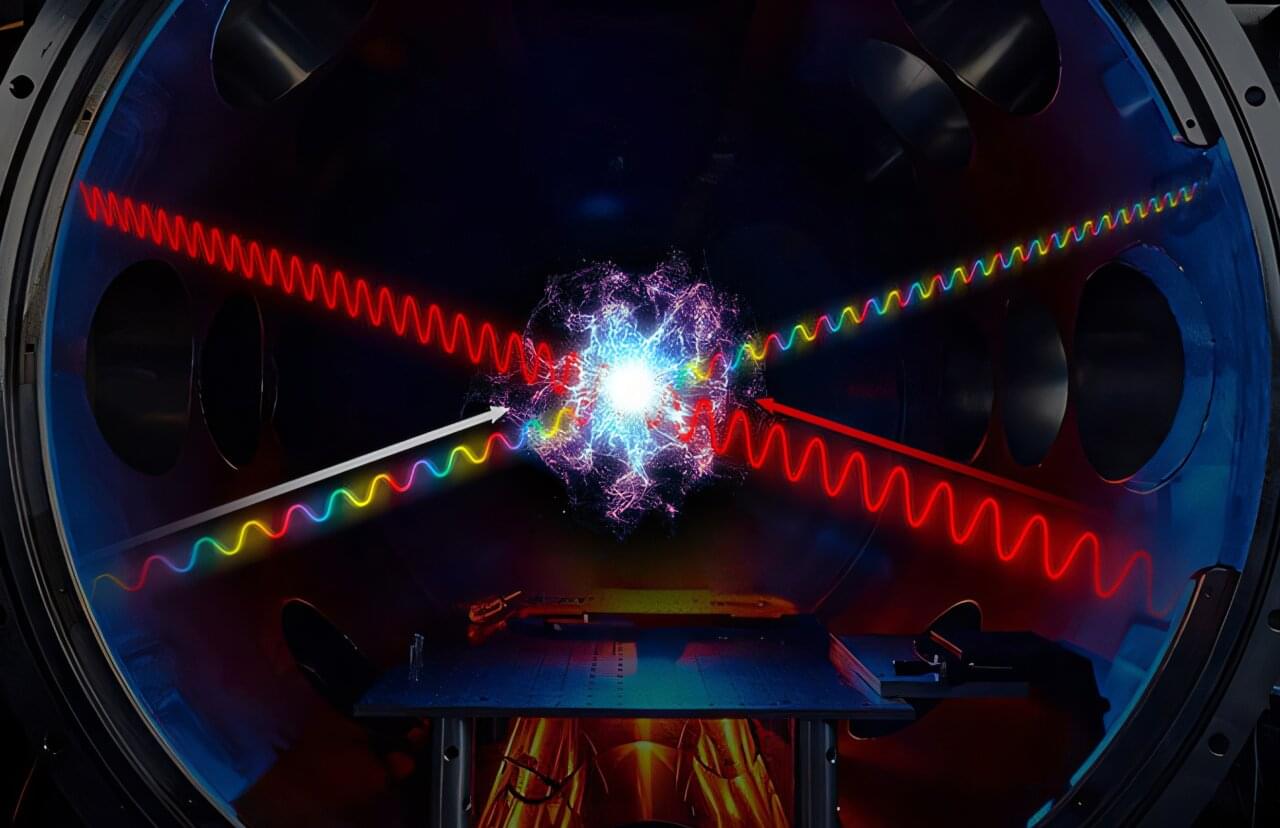
Measuring conditions in volatile clouds of superheated gases known as plasmas is central to pursuing greater scientific understanding of how stars, nuclear detonations and fusion energy work. For decades, scientists have relied on a technique called Thomson scattering, which uses a single laser beam to scatter from plasma waves as a way to measure critical information such as plasma temperature, density and flow.
Now, however, a multidisciplinary team of Lawrence Livermore National Laboratory (LLNL) researchers has successfully demonstrated a potentially simpler, more accurate way to measure plasma conditions with two laser beams that cross paths, creating a data signal that is about a billion times stronger than what is available from the Thomson scattering method.
This method could give physicists working on complex high energy density science and inertial confinement fusion (ICF) research at facilities like LLNL’s National Ignition Facility (NIF) an innovative new tool.