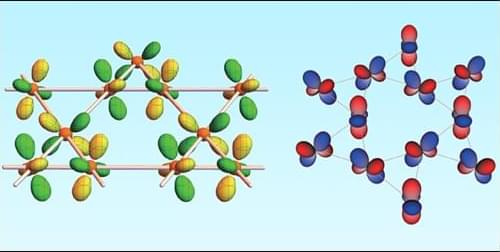
The handedness or chirality of a golf club, a baseball glove, or certain crystal lattices is plain to see: Their structures are such that one cannot be overlaid on its mirror image. Now Takayuki Ishitobi of the Japan Atomic Energy Agency and Kazumasa Hattori of Tokyo Metropolitan University have discovered that a crystal whose atomic structure is achiral can still host a chiral electronic state, which they dub purely electronic chirality (PEC) [1].
Four years ago, theorists found that the chirality of a crystalline structure can be quantified with a single number G0, which is given by the inner product of polar and axial vectors. The polar one is the electric dipole moment. The axial one is the electric toroidal dipole, which quantifies the geometric relationship between the electrons’ spin and orbital axes, and which is present in a few crystals with the requisite intricate arrangement of orbitals. Ishitobi and Hattori sought crystals whose atomic structures were achiral, but in which electronic interactions could induce an electric toroidal dipole and, therefore, a nonzero G0.
In some crystals, the conduction electrons occupy 2D planes. Ishitobi and Hattori realized that, if such a crystal also possesses atoms with electric quadrupole moments, the internal electric field could couple these quadrupoles to the electric toroidal dipole. A PEC would arise if the electric quadrupole has a specific arrangement and if the crystal has a certain lattice structure. From their calculations, the researchers determined that the intermetallic compound uranium rhodium stannide ticks all the boxes. They also found that the adoption of PEC by this material’s electrons could account for an unexplained phase transition at a temperature of 54 K.